Math Trailhead

Worksheet Inverse Functions

1.

Let \(f(x) = {\sqrt{9x-3}}\text{.}\) Find \(f^{-1}(x)\text{.}\)
\(f^{-1}(x) =\)
Hint.
Example: Find the inverse function of \(f(x) = \sqrt{x+1}\)
\(\displaystyle{\begin{aligned} y \amp = \sqrt{x+1}\\ y^2 \amp = x+1\\ y^2-1 \amp =x\\ \end{aligned} }\)
Therefore, \(\displaystyle f^{-1}(y) = y^2-1\) for \(y>0\)
or, \(\displaystyle f^{-1}(x) = \frac{2}{x-4}+3\) for \(x>0\)
Answer.
\(\frac{x^{2}+3}{9}\)

2.

Let \(\displaystyle{f(x) = {\frac{2x}{x+3}}}\text{.}\) Find \(f^{-1}(x)\text{.}\)
\(f^{-1}(x) =\)
Hint.
Example: Find the inverse function of \(f(x) = \frac{2}{x-3} +4\)
\(\displaystyle{\begin{aligned} y \amp = \frac{2}{x-3} +4\\ y-4\amp =\frac{2}{x-3}\\ (y-4)(x-3) \amp =2\\ x-3 \amp =\frac{2}{y-4}\\ x\amp =\frac{2}{y-4}+3\\ \end{aligned} }\)
Therefore, \(\displaystyle f^{-1}(y) = \frac{2}{y-4}+3\)
or, \(\displaystyle f^{-1}(x) = \frac{2}{x-4}+3\)
Answer.
\(-\frac{3x}{x-2}\)

3.

Let \(\displaystyle{f(x) = {\frac{3x+9}{x+6}}}\text{.}\) Find \(f^{-1}(x)\text{.}\)
\(f^{-1}(x) =\)
Hint.
To find the inverse function, first write the function as \(y={\frac{3x+9}{x+6}}\) and then solve for \(x\text{.}\) Then you can switch the \(y\)’s into \(x\)’s to have a function \(f^{-1}(x)\text{.}\)
Answer.
\(\frac{9-6x}{x-3}\)

6.

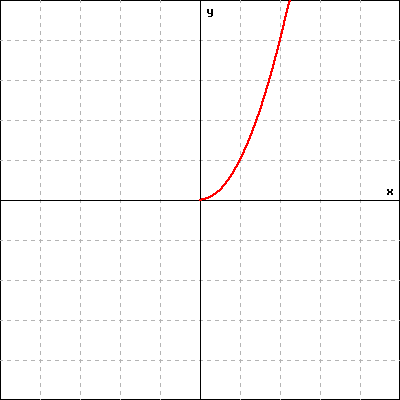
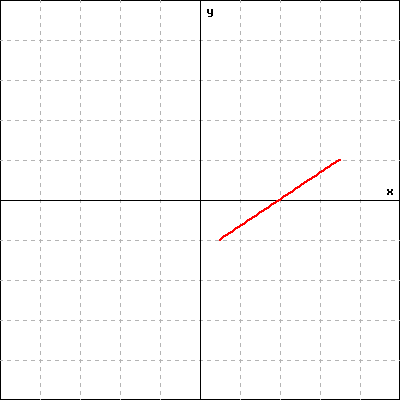
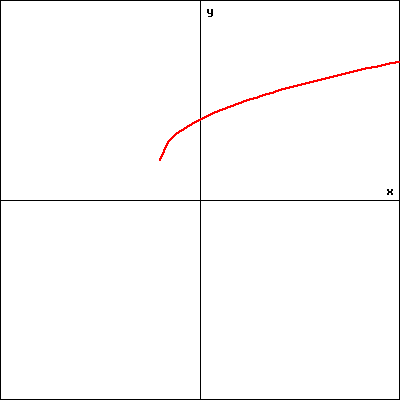
(a) Let the graph of \(f(x)\) be given by:
(Click on graph to enlarge)
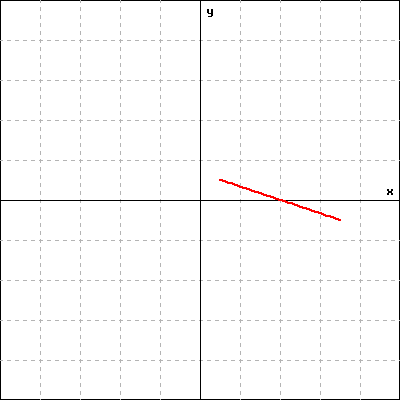
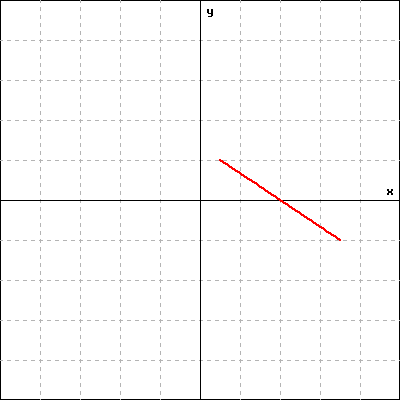
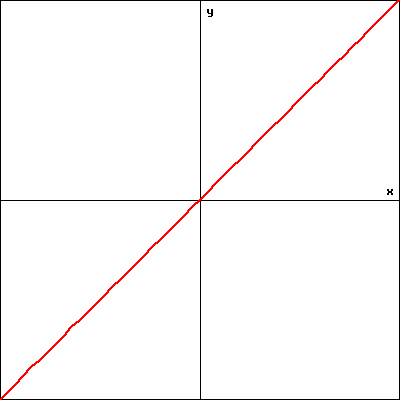
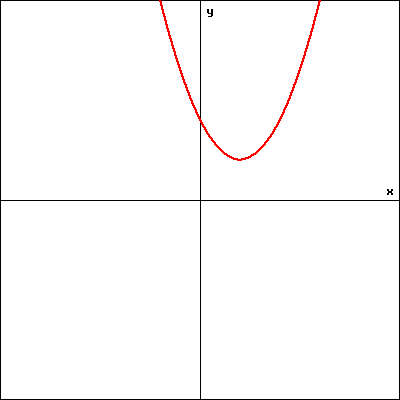
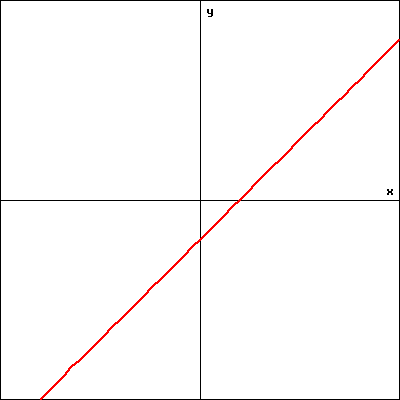
Which of the following is the graph of \(y=f^{-1}(x)\text{?}\)
A B
C D
(Click on a graph to enlarge it.)
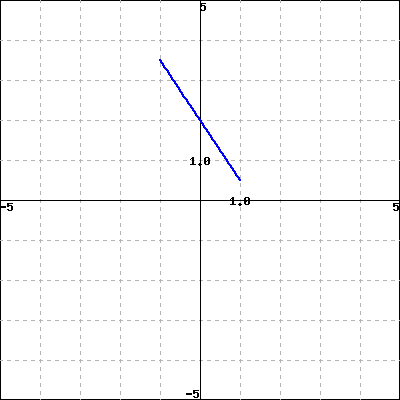
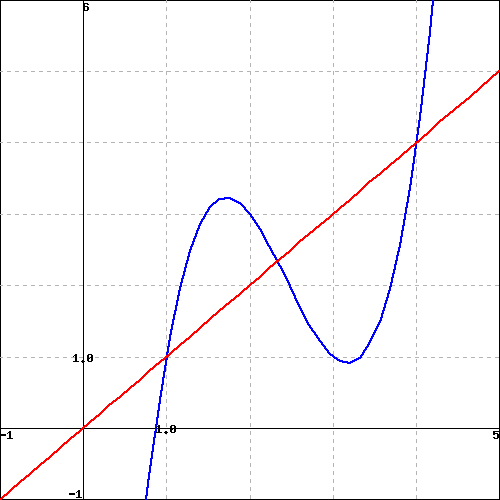
(b) Let the graph of \(g(x)\) be given by:
(Click on graph to enlarge)
Which of the following is the graph of \(y=g^{-1}(x)\text{?}\)
A B
C D
(Click on a graph to enlarge it.)
Answer 1.
\(\text{B}\)
Answer 2.
\(\text{D}\)

7.

Use the table to evaluate the expressions:
\(f(8)=\)
\(f(6)=\)
\(f^{-1}(-4)=\)
\(f^{-1}(-1)=\)
Answer 1.
Answer 2.
Answer 3.
Answer 4.

8.

An object dropped from a height of \(700\) feet has a height, \(h(t)\text{,}\) in feet after \(t\) seconds have elapsed, where \(t\ge 0\text{,}\) such that \(h(t)={700-16t^{2}}\text{.}\) Express \(t\) as a function of height \(h\text{,}\) and find the time to reach a height of \(100\) feet.
Answer 1.
\(\frac{\sqrt{700-h}}{4}\)
Answer 2.
\(\frac{\sqrt{700-100}}{4}\)

10.

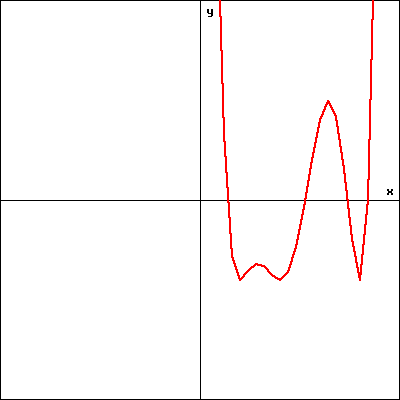
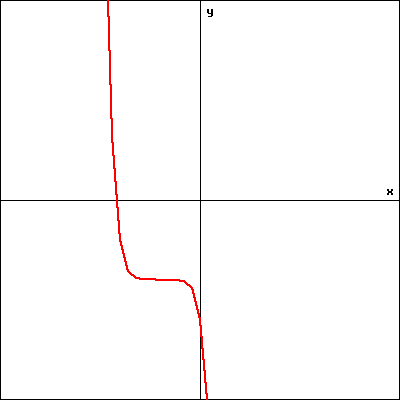
Determine if the following functions are \(one\,to\,one\text{.}\) If the function is one to one then the function has an inverse.
Hint: Use the horizontal line test.
Answer 1.
\(\text{No}\)
Answer 2.
\(\text{Yes}\)
Answer 3.
\(\text{Yes}\)
Answer 4.
\(\text{No}\)
Answer 5.
\(\text{No}\)

12.

To convert from x degrees Celsius to y degrees Fahrenheit, we use the formula \(\displaystyle{ f(x) = \frac{9}{5} x + 32 }\text{.}\) Find the inverse function, if it exists, and be sure you could explain its meaning.
\(f^{-1}(x)=\)
Answer.
\(\frac{5}{9}x-\frac{160}{9}\)

13.

Are the following functions one-to-one?
  1. \(f\text{,}\) where \(\displaystyle f(x) = {x^{2}+4}\)
  2. \(f\text{,}\) where \(\displaystyle f(x) = {\left|x-2\right|}\)
  3. \(f\text{,}\) where \(\displaystyle f(x) = {5x+4}\)
  4. \(f\text{,}\) where \(\displaystyle f(x) = {\frac{1}{x}}\)
Answer 1.
\(\text{No}\)
Answer 2.
\(\text{No}\)
Answer 3.
\(\text{Yes}\)
Answer 4.
\(\text{Yes}\)
Solution.
  1. If we try to solve the equation \(y={x^{2}+4}\) for \(x\text{,}\) then we have
    \(\begin{aligned} y\amp ={x^{2}+4}\\ y-4\amp =x^2\\ x^2\amp =y-4\\ \end{aligned}\)
    At this point we cannot determine what \(x\) is exactly. It could be \(\sqrt{y-4}\) or it could be \(-\sqrt{y-4}\text{.}\) Since we cannot solve for \(x\) in terms of \(y\text{,}\) \({x^{2}+4}\) is not a one-to-one function of \(x\text{.}\)
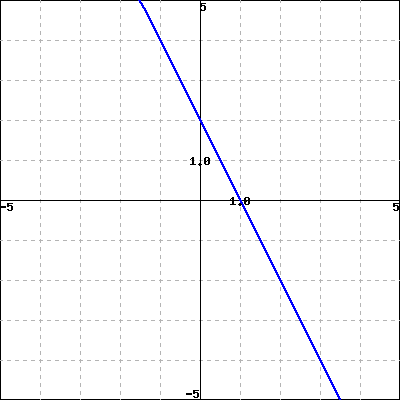
  2. If we try to solve the equation \(y={\left|x-2\right|}\) for \(x\text{,}\) then we have
    \(\begin{aligned} y\amp ={\left|x-2\right|}\\ {\left|x-2\right|}\amp =y\\ \end{aligned}\)
    At this point we cannot determine what \(x\) is exactly. Maybe \(x-2=y\) or maybe \(x-2=-y\text{.}\) So maybe \(x=y+2\) or maybe \(x=-y+2\text{.}\) Since we cannot solve for \(x\) in terms of \(y\text{,}\) \({\left|x-2\right|}\) is not a one-to-one function of \(x\text{.}\)
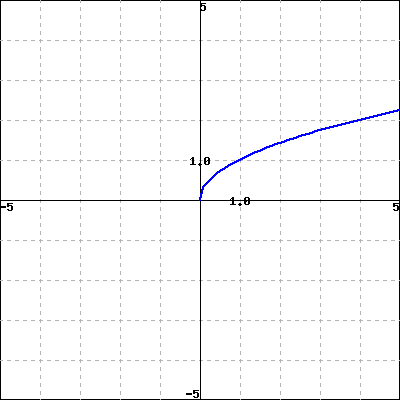
  3. If we try to solve the equation \(y={5x+4}\) for \(x\text{,}\) then we have
    \(\begin{aligned} y\amp ={5x+4}\\ {5x+4}\amp =y\\ 5x\amp =y-4\\ x\amp =\frac{y-4}{5}\\ \end{aligned}\)
    Since we can solve for \(x\) in terms of \(y\text{,}\) \({5x+4}\) is a one-to-one function of \(x\text{.}\)
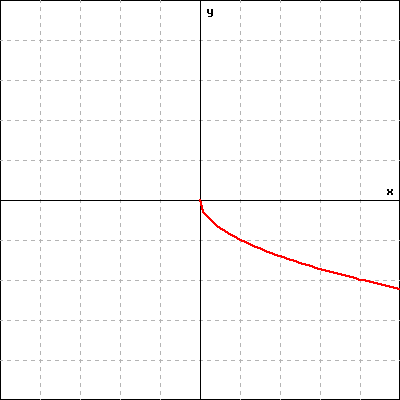
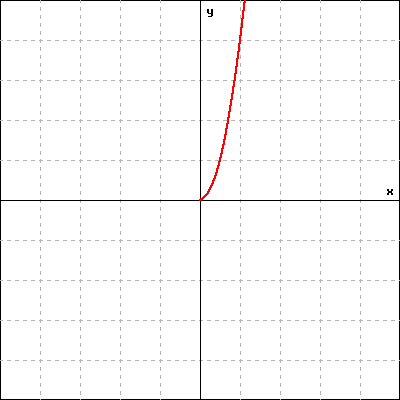
  4. If we try to solve the equation \(y={\frac{1}{x}}\) for \(x\text{,}\) then we have
    \(\begin{aligned} y\amp ={\frac{1}{x}}\\ xy\amp =1\\ x\amp =\frac{1}{y}\\ \end{aligned}\)
    Since we can solve for \(x\) in terms of \(y\text{,}\) \({\frac{1}{x}}\) is a one-to-one function of \(x\text{.}\)
14.

15.

If \(f(x)=\displaystyle \frac{4x+4}{x-4}\text{,}\) then find \(f^{-1}(x)\text{.}\)
Answer.
\(\text{Choice 3}\)

17.

Consider the function
\begin{equation*} f(x) = \frac{x}{8x+3}. \end{equation*}
a) Find the inverse function for \(f\)
\(f^{-1}(x)\)= ,
(b) The domain of \(f\) is { \(x \mid x \ne\) }
(c) The domain of \(f^{-1}\) is { \(x \mid x \ne\) }
(d) The range of \(f\) is { \(y \mid y \ne\) }
(d) The range of \(f^{-1}\) is { \(y \mid y \ne\) }
Answer 1.
\(\frac{3x}{1-8x}\)
Answer 2.
\(\frac{-3}{8}\)
Answer 3.
\(\frac{1}{8}\)
Answer 4.
\(\frac{1}{8}\)
Answer 5.
\(\frac{-3}{8}\)

18.

Find the inverse function of \(g(x) = \frac{ \sqrt{x} + 8}{5 - \sqrt{x}}\text{.}\) If the function is not invertible, enter NONE.
\(g^{-1}(x) =\)
(Write your inverse function in terms of the independent variable \(x\text{.}\))
Answer.
\(\left(\frac{5x-8}{1+x}\right)^{2}\)
Solution.
SOLUTION\(g \left( g^{-1}(x) \right) = x\text{,}\)\(y\)\(g^{-1}(x)\)\(g(y)=x\text{.}\)\(g\)\(\displaystyle g(y) = \frac{ \sqrt{y} + 8}{5 - \sqrt{y}} =x\)\(y\)
\begin{equation*} \begin{aligned} x \amp = g(y) = \frac{ \sqrt{y} + 8}{5 - \sqrt{y}} \\ x(5 - \sqrt{y}) \amp = \sqrt{y}+ 8 \\ 5 x-x \sqrt{y} \amp = \sqrt{y} + 8 \\ 5 x - 8 \amp = \sqrt{y}+x\sqrt{y} \\ 5 x- 8 \amp = \sqrt{y}(1+x) \\ \sqrt{y} \amp = \frac{5 x - 8}{1+x} \\ y \amp = \left( \frac{5 x - 8}{1+x} \right)^2. \end{aligned} \end{equation*}
\(f(x)\)\((-\infty,-1)\cup[8/5,\infty)\text{,}\)
\begin{equation*} f^{-1}(x)=\left(\frac{5 x-8}{1+x}\right)^2, \quad x\in (-\infty,-1)\cup[8/5,\infty). \end{equation*}

20.

Find a formula for the inverse of the function \(\displaystyle g(x) = \frac{e^x}{1+2 e^x}.\)
Answer: \(g^{-1}(x) =\)
Answer.
\(\ln\mathopen{}\left(1x\right)-\ln\mathopen{}\left(1-2x\right)\)