Math Trailhead

Section Trigonometry

A point traveling around a circle creates a repeating wave when we record one of its coordinates. This connects the geometry of the unit circle to the family of functions
\begin{equation*} f(x)=A\cos(wx+T). \end{equation*}
By the end of this lesson, you will be able to read sine and cosine from the unit circle, explain why \(\sin^2\theta+\cos^2\theta=1\text{,}\) and use \(A\text{,}\) \(w\text{,}\) and \(T\) to describe and sketch a cosine wave. You need the Pythagorean theorem, coordinates, and basic algebra; no previous trigonometry lesson is required.
Work with pencil and paper as you read. The interactive exercises are selected from the Math Trailhead’s existing trigonometry worksheets. Enter exact answers such as pi/3 and sqrt(3)/2 unless a problem requests decimals. Use radians unless a degree symbol appears.

Subsection The unit circle: angles become coordinates

The unit circle has center \((0,0)\) and radius \(1\text{.}\) Start at \((1,0)\) and turn through an angle \(\theta\text{.}\) Positive angles turn counterclockwise; negative angles turn clockwise. The angle determines a point on the circle.
An angle in radians is the signed distance traveled along a circle divided by its radius. On the unit circle, the size of the angle equals the arc length. One full turn is \(2\pi\) radians because the circumference is \(2\pi\text{.}\) Therefore
\begin{equation*} 360^\circ=2\pi\text{ radians},\qquad 180^\circ=\pi\text{ radians},\qquad 90^\circ=\frac{\pi}{2}\text{ radians}. \end{equation*}
To convert degrees to radians, multiply by \(\pi/180\text{;}\) to convert radians to degrees, multiply by \(180/\pi\text{.}\) For example, \(120^\circ=2\pi/3\) radians and \(-\pi/4=-45^\circ\text{.}\)
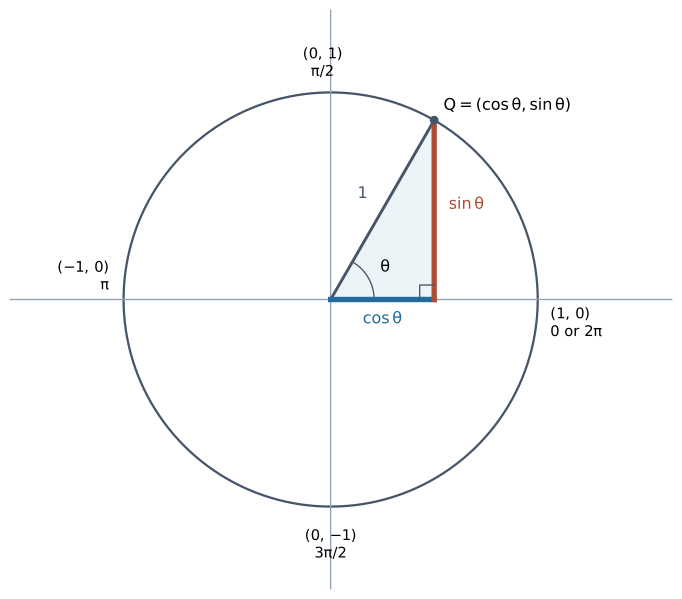
We define cosine to be the horizontal coordinate and sine to be the vertical coordinate:
\begin{equation*} Q=(\cos\theta,\sin\theta). \end{equation*}
A unit circle with a radius to a point in the first quadrant. The horizontal leg is labeled cosine theta, the vertical leg sine theta, and the radius 1. The four axis intercepts are labeled with coordinates and angles 0, pi over 2, pi, and 3 pi over 2.
Figure 62. The radius has length 1. Its horizontal and vertical components are cosine and sine.
In the first quadrant, this agrees with right-triangle trigonometry: cosine is adjacent side divided by hypotenuse and sine is opposite side divided by hypotenuse. Here the hypotenuse is \(1\text{.}\) The coordinate definition continues to work in every quadrant, including points on the axes.
Table 63. Five landmarks in one turn
\(\theta\) \(0\) \(\pi/2\) \(\pi\) \(3\pi/2\) \(2\pi\)
\(\cos\theta\) 1 0 \(-1\) 0 1
\(\sin\theta\) 0 1 0 \(-1\) 0
Signs come from coordinates: in quadrant I both are positive; in II cosine is negative and sine positive; in III both are negative; in IV cosine is positive and sine negative. Also, each coordinate lies between \(-1\) and \(1\text{.}\)
You can reconstruct the familiar exact values. At \(\pi/4\text{,}\) the triangle’s legs have the same length \(a\text{,}\) so \(2a^2=1\) gives \(a=\sqrt{2}/2\text{.}\) Bisect an equilateral triangle of side \(1\text{:}\) the short leg is \(1/2\text{,}\) the hypotenuse is \(1\text{,}\) and the long leg is \(\sqrt{3}/2\text{.}\) This gives the \(\pi/6\) and \(\pi/3\) values.
Table 64. First-quadrant values to reconstruct
Angle \(\cos\theta\) \(\sin\theta\)
\(\pi/6=30^\circ\) \(\sqrt{3}/2\) \(1/2\)
\(\pi/4=45^\circ\) \(\sqrt{2}/2\) \(\sqrt{2}/2\)
\(\pi/3=60^\circ\) \(1/2\) \(\sqrt{3}/2\)
A reference angle is the acute angle from a point’s radius to the horizontal axis. Reflect a first-quadrant point to obtain other quadrants, keeping coordinate magnitudes and changing their signs. For example, \(5\pi/6\) is in quadrant II with reference angle \(\pi/6\text{,}\) so its point is \((-\sqrt{3}/2,1/2)\text{.}\)
Adding or subtracting \(2\pi\) makes one extra full turn and returns to the same point. Thus \(-\pi/6\) and \(11\pi/6\) have the same sine and cosine. This is why both functions repeat every \(2\pi\text{.}\)

Checkpoint 65. Convert degrees to radians.

Convert \(47^{\circ}\) into radian measure:
Convert \(231^{\circ}\) into radian measure:
Convert \(321^{\circ}\) into radian measure:
Convert \(152^{\circ}\) into radian measure:
  • Enter your answer as a fraction of pi
  • You may also use decimal approximation, but your answer must be accurate to at least 3 decimal places.
Hint.
If you’re familiar with unit conversion, this is pretty much the same thing.
You want to multiply by a fraction that’s equivalent to 1 (because multiplying by 1 won’t change the value).
But the fraction will have different units in the numerator and denominator.
In the denominator you put the units that you want to remove, and in the numerator you put the units that you want to end up with.
In this case, you want to remove degrees, and have radians instead.
So you need two equivalent measurements - one in radians, and one in degrees.
Answer 1.
\(\frac{47\pi }{180}\)
Answer 2.
\(\frac{77\pi }{60}\)
Answer 3.
\(\frac{107\pi }{60}\)
Answer 4.
\(\frac{38\pi }{45}\)
Solution.
For converting between radians and degrees, we rely on the fact that \(360^{\circ} = 2\pi\) radians.
This means we can use the conversion factors: \(\frac{2\pi}{360^{\circ}}\) or \(\frac{360^{\circ}}{2\pi}\)
To convert from degrees, to radians, we need to cancel out the existing degrees.
That means putting \(360^{\circ}\) in the denominator.
So we’ll be using \(\frac{2\pi}{360^{\circ}}\text{,}\) which is often reduced: \(\frac{\pi}{180^{\circ}}\)
Note that both fractions are equivalent to 1, since we’re taking a measurement divided by the same measurement.
If you’re having trouble seeing that, think of \(\frac{1 \text{ft}}{12 \text{in}}\) or \(\frac{60 \text{min}}{1 \text{hr}}\text{.}\) They’re both equivalent to 1 as well.
  1. \(\displaystyle 47^{\circ} \rightarrow 47^{\circ} \times \frac{\pi\text{ radians}}{180^{\circ}} \rightarrow \frac{47\pi\text{ radians}}{180} \rightarrow {\frac{47\pi }{180}}\text{ radians}\)
  2. \(\displaystyle 231^{\circ} \rightarrow 231^{\circ} \times \frac{\pi\text{ radians}}{180^{\circ}} \rightarrow \frac{231\pi\text{ radians}}{180} \rightarrow {\frac{77\pi }{60}}\text{ radians}\)
  3. \(\displaystyle 321^{\circ} \rightarrow 321^{\circ} \times \frac{\pi\text{ radians}}{180^{\circ}} \rightarrow \frac{321\pi\text{ radians}}{180} \rightarrow {\frac{107\pi }{60}}\text{ radians}\)
  4. \(\displaystyle 152^{\circ} \rightarrow 152^{\circ} \times \frac{\pi\text{ radians}}{180^{\circ}} \rightarrow \frac{152\pi\text{ radians}}{180} \rightarrow {\frac{38\pi }{45}}\text{ radians}\)

Checkpoint 66. Convert radians to degrees.

Convert \({2.29}\) radians into degrees:
Convert \({0.09}\) radians into degrees:
Convert \({4.09}\) radians into degrees:
Convert \({4.93}\) radians into degrees:
  • You may use decimal approximation, but your answer must be accurate to at least 3 decimal places.
Hint.
If you’re familiar with unit conversion, this is pretty much the same thing.
You want to multiply by a fraction that’s equivalent to 1 (because multiplying by 1 won’t change the value).
But the fraction will have different units in the numerator and denominator.
In the denominator you put the units that you want to remove, and in the numerator you put the units that you want to end up with.
In this case, you want to remove radians, and have degrees instead.
So you need two equivalent measurements - one in radians, and one in degrees.
Answer 1.
\(131.207\)
Answer 2.
\(5.15662\)
Answer 3.
\(234.34\)
Answer 4.
\(282.468\)
Solution.
For converting between radians and degrees, we rely on the fact that \(360^{\circ} = 2\pi\) radians.
This means we can use the conversion factors: \(\frac{2\pi}{360^{\circ}}\) or \(\frac{360^{\circ}}{2\pi}\)
To convert from radians, to degrees, we need to cancel out the existing radians.
That means putting \(2 \pi\) radians in the denominator.
So we’ll be using \(\frac{360^{\circ}}{2\pi\text{ radians}}\text{,}\) which is often reduced: \(\frac{180^{\circ}}{\pi\text{ radians}}\)
Note that both fractions are equivalent to 1, since we’re taking a measurement divided by the same measurement.
If you’re having trouble seeing that, think of \(\frac{1 \text{ft}}{12 \text{in}}\) or \(\frac{60 \text{min}}{1 \text{hr}}\text{.}\) They’re both equivalent to 1 as well.
  1. \(\displaystyle {2.29} \text{ radians} \rightarrow {2.29} \text{ radians} \times \frac{180^{\circ}}{\pi\text{ radians}} \rightarrow \frac{412.2^{\circ}}{\pi} \approx {131.207}^{\circ}\)
  2. \(\displaystyle {0.09} \text{ radians} \rightarrow {0.09} \text{ radians} \times \frac{180^{\circ}}{\pi\text{ radians}} \rightarrow \frac{16.2^{\circ}}{\pi} \approx {5.15662}^{\circ}\)
  3. \(\displaystyle {4.09} \text{ radians} \rightarrow {4.09} \text{ radians} \times \frac{180^{\circ}}{\pi\text{ radians}} \rightarrow \frac{736.2^{\circ}}{\pi} \approx {234.34}^{\circ}\)
  4. \(\displaystyle {4.93} \text{ radians} \rightarrow {4.93} \text{ radians} \times \frac{180^{\circ}}{\pi\text{ radians}} \rightarrow \frac{887.4^{\circ}}{\pi} \approx {282.468}^{\circ}\)

Checkpoint 67. Use coordinate signs to identify quadrants.

From the information given, find the quadrant in which the terminal point determined by \(t\) lies. Input I, II, III, or IV.
(a) \(\sin (t)\lt 0\) and \(\cos (t)\lt 0\text{,}\) quadrant ;
(b) \(\sin (t)>0\) and \(\cos (t)\lt 0\text{,}\) quadrant ;
(c) \(\sin (t)>0\) and \(\cos (t)>0\text{,}\) quadrant ;
(d) \(\sin (t)\lt 0\) and \(\cos (t)>0\text{,}\) quadrant ;
Answer 1.
Answer 2.
Answer 3.
Answer 4.

Checkpoint 68. Read exact cosine values.

Without using a calculator, state the exact value of the following trig functions for the specified angle.
  1. \(\displaystyle{ \cos\left({\frac{\pi }{4}}\right) = }\)
  2. \(\displaystyle{ \cos\left({\frac{3\pi }{4}}\right) = }\)
  3. \(\displaystyle{ \cos\left({\frac{5\pi }{4}}\right) = }\)
  4. \(\displaystyle{ \cos\left({\frac{7\pi }{4}}\right) = }\)
  5. \(\displaystyle{ \cos\left({\frac{9\pi }{4}}\right) = }\)
  6. \(\displaystyle{ \cos\left({\frac{-3\pi }{4}}\right) = }\)
  7. \(\displaystyle{ \cos\left({\frac{-5\pi }{4}}\right) = }\)
  8. \(\displaystyle{ \cos\left({\frac{-7\pi }{4}}\right) = }\)
Hint.
Do you notice anything about all the angles in this problem?
What is the reference angle for each?
And what does that tell you about the cosine of each angle?
Answer 1.
\(\frac{\sqrt{2}}{2}\)
Answer 2.
\(-\frac{\sqrt{2}}{2}\)
Answer 3.
\(-\frac{\sqrt{2}}{2}\)
Answer 4.
\(\frac{\sqrt{2}}{2}\)
Answer 5.
\(\frac{\sqrt{2}}{2}\)
Answer 6.
\(-\frac{\sqrt{2}}{2}\)
Answer 7.
\(-\frac{\sqrt{2}}{2}\)
Answer 8.
\(\frac{\sqrt{2}}{2}\)
Solution.
Right off the bat, you should recognize that all angles appearing in this problem have \({\frac{\pi }{4}}\) as their reference angle.
This means that the only difference in your answers will be whether your answer will be positive or negative.
The answer, of course, depends on the quadrant where \(\theta\) lives.
From our unit circle, we know that \(\cos({\frac{\pi }{4}}) = {\frac{\sqrt{2}}{2}}\text{.}\)
\({\frac{\pi }{4}}\) corresponds to the point \(({\frac{\sqrt{2}}{2}},{\frac{\sqrt{2}}{2}})\) on the unit circle;
and \(\cos(\theta)\) corresponds to the \(x\)-coordinate.
a. This is our reference angle. \({\frac{\pi }{4}}\) is in the first quadrant, where the \(x\)-coordinate (and therefore cosine) is positive.So, \(\cos({\frac{\pi }{4}}) = {\frac{\sqrt{2}}{2}}\text{.}\)
b. \({\frac{3\pi }{4}}\) is in the second quadrant, where the \(x\)-coordinate (and therefore cosine) is negative.So, \(\cos({\frac{3\pi }{4}}) = {-\frac{\sqrt{2}}{2}}\text{.}\)
c. \({\frac{5\pi }{4}}\) is in the third quadrant, where the \(x\)-coordinate (and therefore cosine) is negative.So, \(\cos({\frac{5\pi }{4}}) = {-\frac{\sqrt{2}}{2}}\text{.}\)
d. \({\frac{7\pi }{4}}\) is in the fourth quadrant, where the \(x\)-coordinate (and therefore cosine) is positive.So, \(\cos({\frac{7\pi }{4}}) = {\frac{\sqrt{2}}{2}}\text{.}\)
e. \({\frac{9\pi }{4}}\) is coterminal with \({\frac{\pi }{4}}\text{,}\) and both are in the first quadrant, where the \(x\)-coordinate (and therefore cosine) is positive.So, \(\cos({\frac{9\pi }{4}}) = {\frac{\sqrt{2}}{2}}\text{.}\)
f. \({\frac{-3\pi }{4}}\) is coterminal with \({\frac{5\pi }{4}}\text{,}\) and both are in the third quadrant, where the \(x\)-coordinate (and therefore cosine) is negative.So, \(\cos({\frac{-3\pi }{4}}) = {-\frac{\sqrt{2}}{2}}\text{.}\)
g. \({\frac{-5\pi }{4}}\) is coterminal with \({\frac{3\pi }{4}}\text{,}\) and both are in the second quadrant, where the \(x\)-coordinate (and therefore cosine) is negative.So, \(\cos({\frac{-5\pi }{4}}) = {-\frac{\sqrt{2}}{2}}\text{.}\)
h. \({\frac{-7\pi }{4}}\) is coterminal with \({\frac{\pi }{4}}\text{,}\) and both are in the first quadrant, where the \(x\)-coordinate (and therefore cosine) is positive.So, \(\cos({\frac{-7\pi }{4}}) = {\frac{\sqrt{2}}{2}}\text{.}\)

Checkpoint 69. Read exact sine values.

Without using a calculator, state the exact value of the following trig functions for the specified angle.
  1. \(\displaystyle{ \sin\left({\frac{\pi }{4}}\right) = }\)
  2. \(\displaystyle{ \sin\left({\frac{3\pi }{4}}\right) = }\)
  3. \(\displaystyle{ \sin\left({\frac{5\pi }{4}}\right) = }\)
  4. \(\displaystyle{ \sin\left({\frac{7\pi }{4}}\right) = }\)
  5. \(\displaystyle{ \sin\left({\frac{9\pi }{4}}\right) = }\)
  6. \(\displaystyle{ \sin\left({\frac{-3\pi }{4}}\right) = }\)
  7. \(\displaystyle{ \sin\left({\frac{-5\pi }{4}}\right) = }\)
  8. \(\displaystyle{ \sin\left({\frac{-7\pi }{4}}\right) = }\)
Hint.
Answer 1.
\(\frac{\sqrt{2}}{2}\)
Answer 2.
\(\frac{\sqrt{2}}{2}\)
Answer 3.
\(-\frac{\sqrt{2}}{2}\)
Answer 4.
\(-\frac{\sqrt{2}}{2}\)
Answer 5.
\(\frac{\sqrt{2}}{2}\)
Answer 6.
\(-\frac{\sqrt{2}}{2}\)
Answer 7.
\(\frac{\sqrt{2}}{2}\)
Answer 8.
\(\frac{\sqrt{2}}{2}\)
Solution.
Right off the bat, you should recognize that all angles appearing in this problem have \(\displaystyle{\frac{\pi }{4}}\) as their reference angle.
This means that the only difference in your answers will be whether your answer will be positive or negative.
The answer, of course, depends on the quadrant where \(\theta\) lives.
From our unit circle, we know that \(\sin\left(\displaystyle{\frac{\pi }{4}}\right) = \displaystyle{\frac{\sqrt{2}}{2}}\text{.}\)
\(\displaystyle{\frac{\pi }{4}}\) corresponds to the point \(\left(\displaystyle{\frac{\sqrt{2}}{2}},{\frac{\sqrt{2}}{2}}\right)\) on the unit circle;
and \(\sin(\theta)\) corresponds to the \(y\)-coordinate.
a. This is our reference angle. \(\displaystyle{\frac{\pi }{4}}\) is in the first quadrant, where the \(y\)-coordinate (and therefore sine) is positive.So, \(\sin\left(\displaystyle{\frac{\pi }{4}}\right) = \displaystyle{\frac{\sqrt{2}}{2}}\text{.}\)
b. \(\displaystyle{\frac{3\pi }{4}}\) is in the second quadrant, where the \(y\)-coordinate (and therefore sine) is positive.So, \(\sin\left(\displaystyle{\frac{3\pi }{4}}\right) = \displaystyle{\frac{\sqrt{2}}{2}}\text{.}\)
c. \(\displaystyle{\frac{5\pi }{4}}\) is in the third quadrant, where the \(y\)-coordinate (and therefore sine) is negative.So, \(\sin\left(\displaystyle{\frac{5\pi }{4}}\right) = \displaystyle{-\frac{\sqrt{2}}{2}}\text{.}\)
d. \(\displaystyle{\frac{7\pi }{4}}\) is in the fourth quadrant, where the \(y\)-coordinate (and therefore sine) is negative.So, \(\sin\left(\displaystyle{\frac{7\pi }{4}}\right) = \displaystyle{-\frac{\sqrt{2}}{2}}\text{.}\)
e. \(\displaystyle{\frac{9\pi }{4}}\) is coterminal with \(\displaystyle{\frac{\pi }{4}}\text{,}\) and both are in the first quadrant, where the \(y\)-coordinate (and therefore sine) is positive.So, \(\sin\left(\displaystyle{\frac{9\pi }{4}}\right) = \displaystyle{\frac{\sqrt{2}}{2}}\text{.}\)
f. \(\displaystyle{\frac{-3\pi }{4}}\) is coterminal with \({\frac{5\pi }{4}}\text{,}\) and both are in the third quadrant, where the \(y\)-coordinate (and therefore sine) is negative.So, \(\sin\left(\displaystyle{\frac{-3\pi }{4}}\right) = \displaystyle{-\frac{\sqrt{2}}{2}}\text{.}\)
g. \(\displaystyle{\frac{-5\pi }{4}}\) is coterminal with \(\displaystyle{\frac{3\pi }{4}}\text{,}\) and both are in the second quadrant, where the \(y\)-coordinate (and therefore sine) is positive.So, \(\sin({\frac{-5\pi }{4}}) = {\frac{\sqrt{2}}{2}}\text{.}\)
h. \(\displaystyle{\frac{-7\pi }{4}}\) is coterminal with \({\frac{\pi }{4}}\text{,}\) and both are in the first quadrant, where the \(y\)-coordinate (and therefore sine) is positive.So, \(\sin({\frac{-7\pi }{4}}) = {\frac{\sqrt{2}}{2}}\text{.}\)

Subsection One circle, one identity

Every point \((u,v)\) on the unit circle is one unit from the origin. The Pythagorean theorem says \(u^2+v^2=1\text{.}\) Substitute \(u=\cos\theta\) and \(v=\sin\theta\text{:}\)
\begin{equation*} \boxed{\cos^2\theta+\sin^2\theta=1.} \end{equation*}
That is the whole derivation. The notation \(\sin^2\theta\) means \((\sin\theta)^2\text{,}\) not \(\sin(\theta^2)\text{.}\) In other quadrants, the triangle’s side lengths are the absolute values of the coordinates. Squaring removes the signs, so the same identity holds for every angle, including the axis points.

Example 70. Recover a missing coordinate.

If \(\cos\theta=-3/5\) and \(\theta\) is in quadrant II, find \(\sin\theta\text{.}\)
Solution.
The identity gives
\begin{equation*} \sin^2\theta=1-\frac{9}{25}=\frac{16}{25}. \end{equation*}
So \(\sin\theta=\pm4/5\text{.}\) Quadrant II has positive vertical coordinate, hence \(\sin\theta=4/5\text{.}\) The identity determines the magnitude; the quadrant determines the sign.

Checkpoint 71. Explain the identity.

Draw a unit circle and explain the identity in one sentence. Then find \(\cos\theta\) when \(\sin\theta=-5/13\) and \(\theta\) is in quadrant III. Finally, simplify \(1-\sin^2\theta\text{.}\)
Solution.
The squared coordinates of a point on a circle of radius \(1\) sum to \(1\text{.}\) Here \(\cos^2\theta=1-25/169=144/169\text{;}\) quadrant III makes cosine negative, so \(\cos\theta=-12/13\text{.}\) For every angle, \(1-\sin^2\theta=\cos^2\theta\text{.}\)

Subsection From a circle to a wave

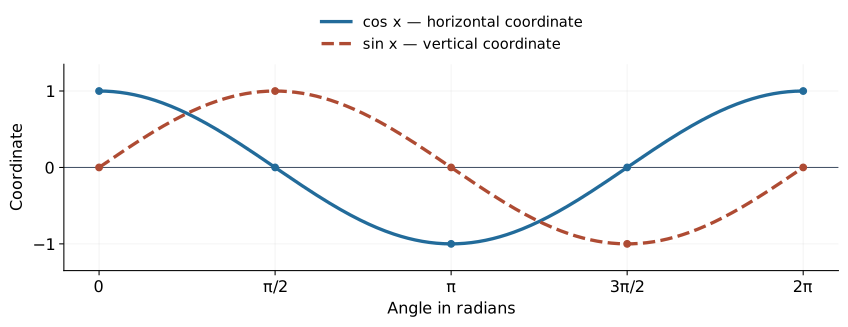
Now let the angle vary and graph its horizontal coordinate against the angle. This produces \(y=\cos x\text{.}\) As the point goes around the circle, its horizontal coordinate follows the pattern \(1,0,-1,0,1\) at the five landmarks above. Plotting the vertical coordinate instead gives \(y=\sin x\text{,}\) with pattern \(0,1,0,-1,0\text{.}\)
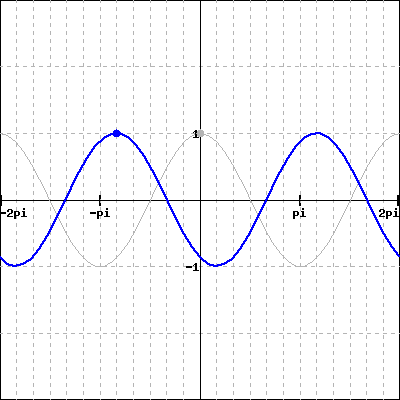
Graphs of cosine and sine from zero to two pi with values marked at every quarter turn. Cosine starts at one; sine starts at zero and rises. Both return to their initial values after two pi.
Figure 72. Cosine and sine record two coordinates of the same circular motion. Both repeat after one full turn.
The midline is the line halfway between the maximum and minimum; here it is \(y=0\text{.}\) The amplitude is the distance from the midline to a peak; here it is \(1\text{.}\) The period is the length of the shortest positive horizontal shift that repeats the entire graph; here it is \(2\pi\text{.}\) A maximum and the next minimum are only half a period apart.
Sine has the same shape as cosine, shifted right by a quarter turn:
\begin{equation*} \sin x=\cos\left(x-\frac{\pi}{2}\right). \end{equation*}
To see this on the circle, rotate \((u,v)\) clockwise by a quarter turn. Its coordinates become \((v,-u)\text{,}\) so the new horizontal coordinate is the old vertical coordinate. This also lets us describe sine waves using the cosine family.

Subsection What A, w, and T do

In \(f(x)=A\cos(wx+T)\text{,}\) call the angle inside cosine \(\theta=wx+T\text{.}\) Starting with an input \(x\text{,}\) first compute this angle, then read its horizontal coordinate on the unit circle, then multiply that coordinate by \(A\text{.}\) The parameter \(w\) is often written as the Greek letter \(\omega\text{.}\) We use \(P\) for the period: \(T\) here is an angle, not the period.

A controls vertical size and reflection.

Multiplying by \(A\) multiplies every height by \(A\text{.}\) Thus \(3\cos x\) ranges from \(-3\) to \(3\text{,}\) and \(\tfrac12\cos x\) ranges from \(-1/2\) to \(1/2\text{.}\) A negative \(A\) also reflects the graph across the horizontal axis: \(-3\cos x\) begins at \(-3\) rather than \(3\text{.}\) Amplitude is a distance, so it is \(|A|\text{,}\) never negative.

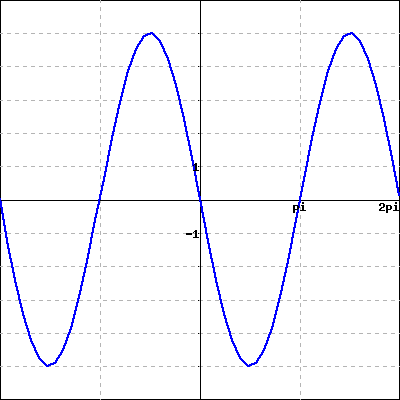
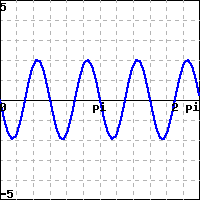
Checkpoint 74. Read amplitude from a graph.

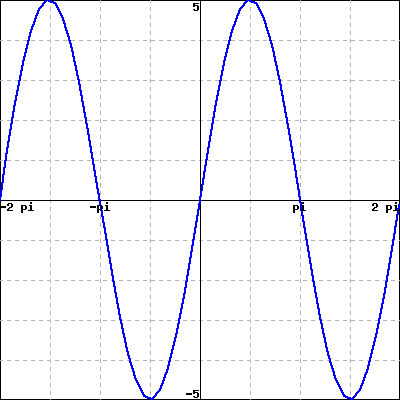
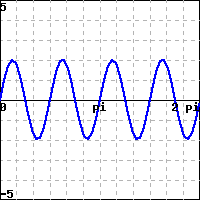
Does this graph have the shape of \(\sin(x)\) or \(\cos(x)\text{?}\)
What is the amplitude of the graphed function?
State the formula for the function that is graphed above. \(y =\)
Hint.
Do you recall the difference between the graphs of sine and cosine?\(\sin(x)\) passes through the origin, and \(\cos(x)\) does not.
Amplitude is used to describe the height of the wave.How high does this wave get?
Remember that the formula for a sine or cosine wave looks like:\(y = A \sin(x)\) or \(y = A \cos(x)\)
where \(A\) represents the amplitude.
Answer 1.
\(\sin\mathopen{}\left(x\right)\)
Answer 2.
Answer 3.
\(5\sin\mathopen{}\left(x\right)\)
Solution.
We can tell that this is a graph of \(\sin(x)\) because we pass through the origin.
Our amplitude must be \(5\) because our graph extends up to \(5\) and down to \(-5\) on the \(y\)-axis.
Therefore, our formula for this graph is \(y={5\sin\mathopen{}\left(x\right)}\text{.}\)

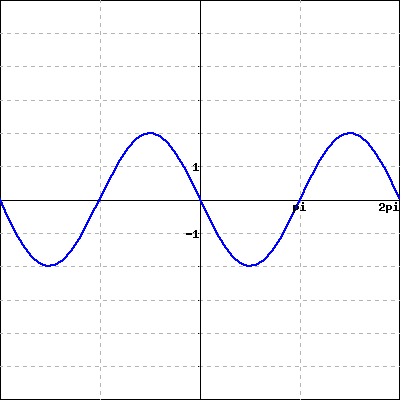
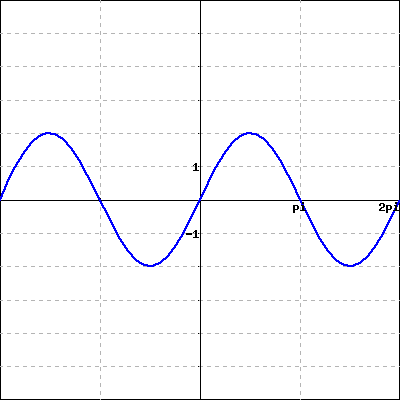
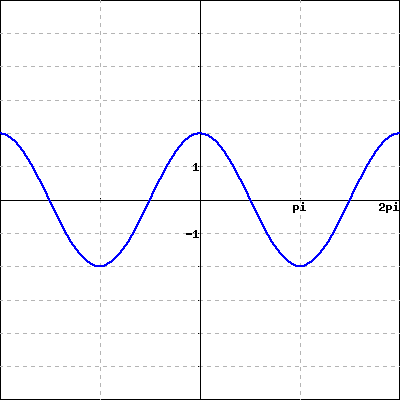
Checkpoint 75. Match amplitudes and reflections.

Practice
Match the equations given below with their corresponding graphs:
Graph A
Graph B
Graph C
Graph D
Graph E
Graph F
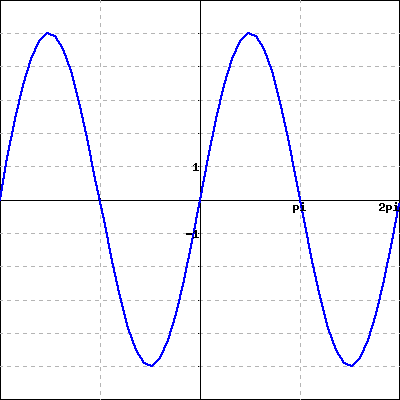
  1. \(y = {2\cos\mathopen{}\left(x\right)}\) is shown in graph
  2. \(y = {5\sin\mathopen{}\left(x\right)}\) is shown in graph
  3. \(y = {-2\sin\mathopen{}\left(x\right)}\) is shown in graph
  4. \(y = {2\sin\mathopen{}\left(x\right)}\) is shown in graph
Answer 1.
\(\text{E}\)
Answer 2.
\(\text{A}\)
Answer 3.
\(\text{C}\)
Answer 4.
\(\text{D}\)
Solution.
  1. \(y = {2\cos\mathopen{}\left(x\right)}\) is the graph of cosine with positive coefficient and amplitude 2; this corresponds to graph E.
  2. \(y = {5\sin\mathopen{}\left(x\right)}\) is the graph of sine with positive coefficient and amplitude 5; this corresponds to graph A.
  3. \(y = {-2\sin\mathopen{}\left(x\right)}\) is the graph of sine with negative coefficient (so it is the vertically-reflected, or ’upside-down’, version of sine) and amplitude 2; this corresponds to graph C.
  4. \(y = {2\sin\mathopen{}\left(x\right)}\) is the graph of sine with positive coefficient and amplitude 2; this corresponds to graph D.

w controls how quickly the angle changes.

Increasing \(x\) by \(\Delta x\) changes the angle by \(w\Delta x\text{.}\) A complete turn requires an angular change of size \(2\pi\text{.}\) For \(A\ne0\) and \(w\ne0\text{,}\)
\begin{equation*} |w|P=2\pi,\qquad \boxed{P=\frac{2\pi}{|w|}.} \end{equation*}
For example, \(\cos(2x)\) makes a full turn while \(x\) increases by only \(\pi\text{;}\) its graph is horizontally compressed. The graph of \(\cos(x/2)\) needs \(4\pi\) units for a turn and is horizontally stretched. Larger \(|w|\) means a shorter period.
If \(w<0\text{,}\) the angle decreases as \(x\) increases, so the point travels clockwise. The period still uses \(|w|\text{.}\) Reflecting the circle across the horizontal axis shows \(\cos(-\theta)=\cos\theta\text{,}\) so \(\cos(-2x)=\cos(2x)\text{.}\) With a nonzero phase angle, keep track of that sign too: \(\cos(-2x+T)=\cos(2x-T)\text{.}\)

Checkpoint 76. Match graphs by their periods.

Practice
Match the equations given below with their corresponding graphs:
Graph A
Graph B
Graph C
Graph D
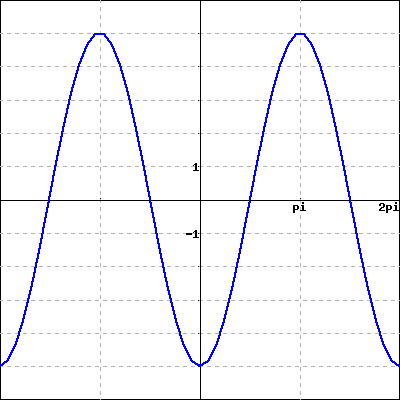
Graph E
Graph F
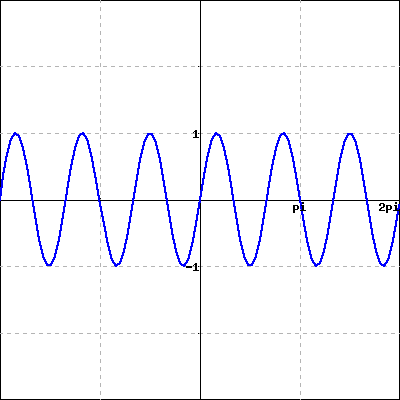
  1. \(y = {\sin\mathopen{}\left(3x\right)}\) is shown in graph
  2. \(y = {\cos\mathopen{}\left(\frac{x}{2}\right)}\) is shown in graph
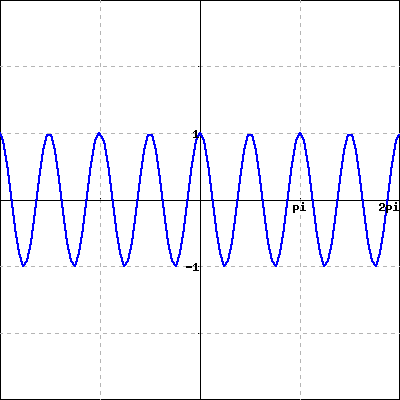
  3. \(y = {\sin\mathopen{}\left(4x\right)}\) is shown in graph
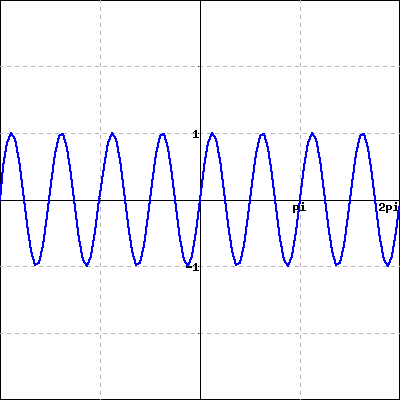
  4. \(y = {\cos\mathopen{}\left(3x\right)}\) is shown in graph
Answer 1.
\(\text{A}\)
Answer 2.
\(\text{F}\)
Answer 3.
\(\text{C}\)
Answer 4.
\(\text{D}\)
Solution.
  1. \(y = {\sin\mathopen{}\left(3x\right)}\) is the graph of \(\sin(\theta)\) with \(\theta = {3x}\text{;}\)
    A complete oscillation (period) for sine happens at \(\theta = 2\pi\text{,}\) which corresponds to \({3x} = 2\pi\) (or \(x = {\frac{2\pi }{3}}\));
    With a period of \({\frac{2\pi }{3}}\text{,}\) we get \({3}\) oscillations between \(0\) and \(2\pi\text{;}\) this corresponds to graph A.
  2. \(y = {\cos\mathopen{}\left(\frac{x}{2}\right)}\) is the graph of \(\cos(\theta)\) with \(\theta = {\frac{x}{2}}\text{;}\)
    A complete oscillation (period) for cosine happens at \(\theta = 2\pi\text{,}\) which corresponds to \({\frac{x}{2}} = 2\pi\) (or \(x = {4\pi }\));
    With a period of \({4\pi }\text{,}\) we get \({\frac{1}{2}}\) an oscillation between \(0\) and \(2\pi\text{;}\) this corresponds to graph F.
  3. \(y = {\sin\mathopen{}\left(4x\right)}\) is the graph of \(\sin(\theta)\) with \(\theta = {4x}\text{;}\)
    A complete oscillation (period) for sine happens at \(\theta = 2\pi\text{,}\) which corresponds to \({4x} = 2\pi\) (or \(x = {\frac{\pi }{2}}\));
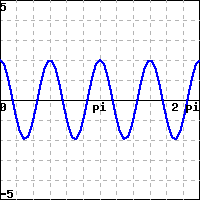
    With a period of \({\frac{\pi }{2}}\text{,}\) we get \({4}\) oscillations between \(0\) and \(2\pi\text{;}\) this corresponds to graph C.
  4. \(y = {\cos\mathopen{}\left(3x\right)}\) is the graph of \(\cos(\theta)\) with \(\theta = {3x}\text{;}\)
    A complete oscillation (period) for cosine happens at \(\theta = 2\pi\text{,}\) which corresponds to \({3x} = 2\pi\) (or \(x = {\frac{2\pi }{3}}\));
    With a period of \({\frac{2\pi }{3}}\text{,}\) we get \({3}\) oscillations between \(0\) and \(2\pi\text{;}\) this corresponds to graph D.

T controls the starting angle.

At \(x=0\text{,}\) the angle is \(T\text{,}\) so \(f(0)=A\cos T\text{.}\) To locate the horizontal shift, factor out \(w\text{:}\)
\begin{equation*} w x+T=w\left(x+\frac{T}{w}\right)=w(x-h), \qquad \boxed{h=-\frac{T}{w}.} \end{equation*}
The graph of \(A\cos(w(x-h))\) is the graph of \(A\cos(wx)\) shifted right by \(h\) if \(h>0\text{,}\) or left by \(|h|\) if \(h<0\text{.}\) Equivalently, solve \(w x+T=0\) to find where the original angle-zero point has moved.
For example, \(\cos(2x+\pi/2)=\cos(2(x+\pi/4))\) shifts \(\cos(2x)\) left by \(\pi/4\text{,}\) not \(\pi/2\text{.}\) The plus sign describes a head start around the circle. The graph reaches a given angle earlier, which explains the shift to the left when \(w>0\text{.}\)
Changing \(T\) does not change amplitude or period. Adding \(2\pi k\) to \(T\text{,}\) for any integer \(k\text{,}\) gives the same function; horizontal shifts that differ by whole periods are equivalent. If you change \(w\) while keeping \(T\) fixed, both the period and the shift \(-T/w\) generally change.
Table 77. The nonconstant family at a glance
Feature \(A\cos(wx+T)\text{,}\) with \(A,w\ne0\)
Amplitude \(|A|\)
Midline and range \(y=0\text{;}\) \([-|A|,|A|]\)
Period \(P=2\pi/|w|\)
Horizontal shift \(h=-T/w\)
Value at zero \(A\cos T\)
Two exceptions deserve their own check: if \(A=0\text{,}\) then \(f(x)=0\text{;}\) if \(w=0\text{,}\) then \(f(x)=A\cos T\) is constant. Constant functions have no smallest positive period. In particular, do not divide by \(w\) when \(w=0\text{.}\)

Checkpoint 78. Read the inside carefully.

For \(g(x)=-2\cos(3x-\pi)\text{,}\) find the amplitude, period, horizontal shift, and \(g(0)\text{.}\) Explain why its amplitude is not negative and its shift is not \(\pi\text{.}\)
Solution.
The amplitude is \(2\text{,}\) the period is \(2\pi/3\text{,}\) and \(3x-\pi=3(x-\pi/3)\) gives a shift right by \(\pi/3\text{.}\) Also \(g(0)=-2\cos(-\pi)=2\text{.}\) The minus sign reflects the graph; amplitude is a positive distance. The phase angle must be divided by the coefficient of \(x\) to find the shift.

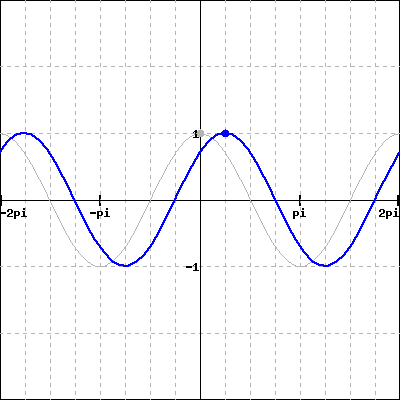
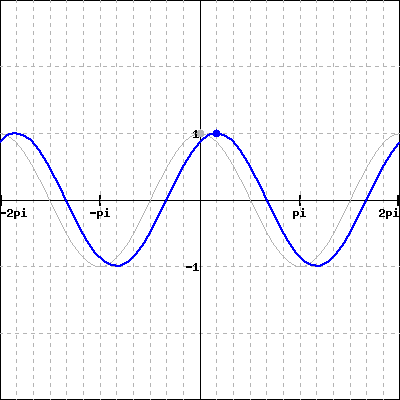
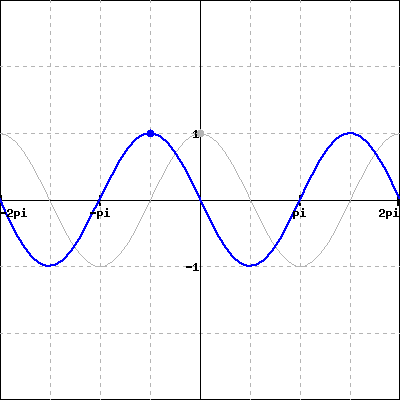
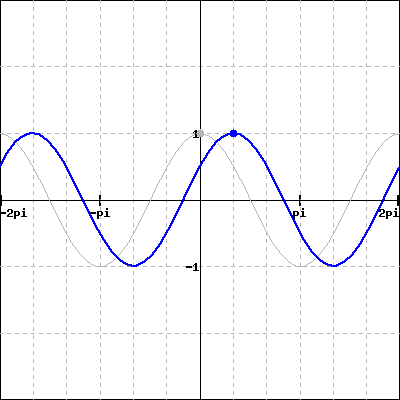
Checkpoint 79. Write equations for shifted cosine graphs.

Practice
Enter an equation for each graph:
Graph A: \(y =\)
Graph B: \(y =\)
Graph C: \(y =\)
Graph D: \(y =\)
Graph E: \(y =\)
Graph F: \(y =\)
Answer 1.
\(\cos\mathopen{}\left(x+\frac{\pi }{3}\right)\)
Answer 2.
\(\cos\mathopen{}\left(x-\frac{\pi }{4}\right)\)
Answer 3.
\(\cos\mathopen{}\left(x-\frac{\pi }{6}\right)\)
Answer 4.
\(\cos\mathopen{}\left(x+\frac{\pi }{2}\right)\)
Answer 5.
\(\cos\mathopen{}\left(x-\frac{\pi }{3}\right)\)
Answer 6.
\(\cos\mathopen{}\left(x+\frac{5\pi }{6}\right)\)
Solution.
  1. Graph A is a cosine wave that has been shifted to the left;
    Looking at the grid lines, we see that the interval between 0 and \(\pi\) has been split into thirds, and our graph has been shifted left by one of those thirds.
    If we want an equation for the cosine wave that has been shifted left by one-thirds of \(\pi\text{,}\) we need to take \(y = \cos(x)\) and replace \(x\) by \(\left( {x+\frac{\pi }{3}} \right)\text{.}\)
    Therefore, our equation for Graph A is \(y = {\cos\mathopen{}\left(x+\frac{\pi }{3}\right)}\text{.}\)
  2. Graph B is a cosine wave that has been shifted to the right;
    Looking at the grid lines, we see that the interval between 0 and \(\pi\) has been split into quarters, and our graph has been shifted right by one of those quarters.
    If we want an equation for the cosine wave that has been shifted right by one-quarters of \(\pi\text{,}\) we need to take \(y = \cos(x)\) and replace \(x\) by \(\left( {x-\frac{\pi }{4}} \right)\text{.}\)
    Therefore, our equation for Graph B is \(y = {\cos\mathopen{}\left(x-\frac{\pi }{4}\right)}\text{.}\)
  3. Graph C is a cosine wave that has been shifted to the right;
    Looking at the grid lines, we see that the interval between 0 and \(\pi\) has been split into sixths, and our graph has been shifted right by one of those sixths.
    If we want an equation for the cosine wave that has been shifted right by one-sixths of \(\pi\text{,}\) we need to take \(y = \cos(x)\) and replace \(x\) by \(\left( {x-\frac{\pi }{6}} \right)\text{.}\)
    Therefore, our equation for Graph C is \(y = {\cos\mathopen{}\left(x-\frac{\pi }{6}\right)}\text{.}\)
  4. Graph D is a cosine wave that has been shifted to the left;
    Looking at the grid lines, we see that the interval between 0 and \(\pi\) has been split into halves, and our graph has been shifted left by one of those halves.
    If we want an equation for the cosine wave that has been shifted left by one-halves of \(\pi\text{,}\) we need to take \(y = \cos(x)\) and replace \(x\) by \(\left( {x+\frac{\pi }{2}} \right)\text{.}\)
    Therefore, our equation for Graph D is \(y = {\cos\mathopen{}\left(x+\frac{\pi }{2}\right)}\text{.}\)
  5. Graph E is a cosine wave that has been shifted to the right;
    Looking at the grid lines, we see that the interval between 0 and \(\pi\) has been split into thirds, and our graph has been shifted right by one of those thirds.
    If we want an equation for the cosine wave that has been shifted right by one-thirds of \(\pi\text{,}\) we need to take \(y = \cos(x)\) and replace \(x\) by \(\left( {x-\frac{\pi }{3}} \right)\text{.}\)
    Therefore, our equation for Graph E is \(y = {\cos\mathopen{}\left(x-\frac{\pi }{3}\right)}\text{.}\)
  6. Graph F is a cosine wave that has been shifted to the left;
    Looking at the grid lines, we see that the interval between 0 and \(\pi\) has been split into sixths, and our graph has been shifted left by five of those sixths.
    If we want an equation for the cosine wave that has been shifted left by five-sixths of \(\pi\text{,}\) we need to take \(y = \cos(x)\) and replace \(x\) by \(\left( {x+\frac{5\pi }{6}} \right)\text{.}\)
    Therefore, our equation for Graph F is \(y = {\cos\mathopen{}\left(x+\frac{5\pi }{6}\right)}\text{.}\)

Subsection Build a graph, then read an equation from a graph

For \(w>0\text{,}\) the five quarter-turn landmarks occur at \(x=h,h+P/4,h+P/2,h+3P/4,h+P\text{.}\) Their heights are \(A,0,-A,0,A\text{.}\) This works even when \(A<0\text{:}\) the first point is then a minimum. Join the landmarks with a smooth wave and repeat.

Example 80. Sketch \(f(x)=3\cos(2x+\pi/2)\).

Find its amplitude, period, and shift, and sketch one cycle.
Solution.
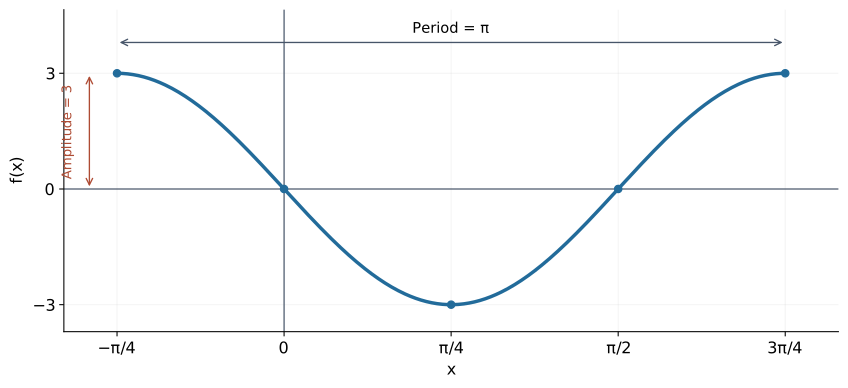
Here \(A=3\text{,}\) \(w=2\text{,}\) and \(T=\pi/2\text{.}\) The amplitude is \(3\text{,}\) \(P=\pi\text{,}\) and \(h=-\pi/4\text{.}\) Each quarter period has length \(\pi/4\text{.}\)
Table 81. Follow the angle inside cosine
\(x\) \(-\pi/4\) \(0\) \(\pi/4\) \(\pi/2\) \(3\pi/4\)
\(2x+\pi/2\) \(0\) \(\pi/2\) \(\pi\) \(3\pi/2\) \(2\pi\)
\(f(x)\) \(3\) \(0\) \(-3\) \(0\) \(3\)
The graph starts this cycle at a maximum, falls through the midline, reaches a minimum, and returns to the maximum. As a check, \(f(0)=3\cos(\pi/2)=0\text{.}\)
A cosine wave through the five points negative pi over four, three; zero, zero; pi over four, negative three; pi over two, zero; and three pi over four, three. Amplitude three and period pi are marked.
Figure 82. One cycle of \(3\cos(2x+\pi/2)\text{.}\) The peak has moved left to \(-\pi/4\text{,}\) and consecutive peaks are \(\pi\) apart.

Example 83. Choose parameters from a graph.

A cosine-shaped wave has maximum \(2\text{,}\) minimum \(-2\text{,}\) and consecutive maxima at \(x=1\) and \(x=5\text{.}\) Find an equation.
Solution.
The midline is \(0\) and the amplitude is \((2-(-2))/2=2\text{.}\) Choose \(A=2\text{.}\) The period is \(5-1=4\text{,}\) so choose \(w=2\pi/4=\pi/2\text{.}\) Place a peak at \(h=1\text{:}\)
\begin{equation*} f(x)=2\cos\left(\frac{\pi}{2}(x-1)\right) =2\cos\left(\frac{\pi}{2}x-\frac{\pi}{2}\right). \end{equation*}
Thus one choice is \(T=-\pi/2\text{.}\) Check that the minimum lies halfway between the two maxima, at \(x=3\text{.}\)

Checkpoint 84. Combine amplitude and period.

\(\displaystyle{ y = {-2\sin\mathopen{}\left(4x\right)} }\)
What is the amplitude of the given function?
What is the period of the given function?
A B
C D
Which graph matches the given function?
Hint.
First, remember that the amplitude is given by the coefficient \(A\) of \(A \sin(x)\) or \(A \cos(x)\text{.}\)
Then, remember that from a function \(\sin( B x )\) or \(\cos( B x )\text{,}\) the period \(p\) is given by the equation \(\displaystyle{ p = \frac{ 2 \pi }{ B } }\text{.}\)
Answer 1.
Answer 2.
\(\frac{2\pi }{4}\)
Answer 3.
\(\text{C}\)

A useful extension: move the midline.

Some Trailhead problems include a vertical translation: \(f(x)=D+A\cos(wx+T)\text{.}\) The added \(D\) moves the midline to \(y=D\text{;}\) the maximum and minimum become \(D+|A|\) and \(D-|A|\text{.}\) Amplitude, period, and horizontal shift stay the same. For instance, \(4+2\cos(3x)\) has midline \(4\text{,}\) range \([2,6]\text{,}\) and period \(2\pi/3\text{.}\)
The same transformation rules apply to \(D+A\sin(w(x-h))\text{.}\) For \(w>0\text{,}\) its quarter-cycle heights, starting at \(x=h\text{,}\) are \(D,D+A,D,D-A,D\text{.}\) If you convert it to cosine using the quarter-turn identity, its phase angle is \(T=-wh-\pi/2\text{.}\)

Checkpoint 85. Extension: describe a shifted sine wave.

Use the trigonometric function \(f(x) = 4\sin\left(\displaystyle\frac{\pi}{4}(x-2)\right)+5\) to answer the following questions.
What is the amplitude of \(f(x)\text{?}\)
What is the period of \(f(x)\text{?}\)
What is the maximum value of \(f(x)\text{?}\)
What is the minimum value of \(f(x)\) ?
What is the midline of \(f(x)\text{?}\)
The phase shift of \(f(x)\) is units
.
Answer 1.
Answer 2.
Answer 3.
Answer 4.
Answer 5.
\(\text{y=}\)
Answer 6.
Answer 7.
Answer 8.
\(\text{right}\)

Checkpoint 86. Check your understanding.

  1. Sketch one cycle of \(2\cos(x/2-\pi/2)\) by listing its five quarter-turn points. State its amplitude, period, and shift.
  2. A wave with midline \(0\) has amplitude \(4\text{,}\) period \(6\text{,}\) and a maximum at \(x=-1\text{.}\) Write one equation in the form \(A\cos(wx+T)\text{.}\)
  3. A classmate says \(\cos^2(2x)+\sin^2(2x)=2\) because the angle doubles. Explain the mistake using the circle.
Solution.
  1. Amplitude \(2\text{,}\) period \(4\pi\text{,}\) shift right \(\pi\text{.}\) The points are \((\pi,2)\text{,}\) \((2\pi,0)\text{,}\) \((3\pi,-2)\text{,}\) \((4\pi,0)\text{,}\) and \((5\pi,2)\text{.}\)
  2. Choose \(A=4\text{,}\) \(w=\pi/3\text{,}\) and \(T=\pi/3\text{,}\) giving \(4\cos(\pi x/3+\pi/3)\text{.}\) At \(x=-1\) the angle is zero; six units later it is \(2\pi\text{.}\)
  3. The angle \(2x\) still locates a point on a circle of radius \(1\text{.}\) Its squared coordinates sum to \(1\text{.}\) Changing the angle changes the point, not the radius.