Math Trailhead

Worksheet Graphing

2.

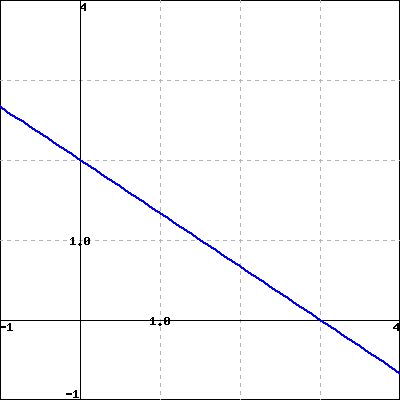
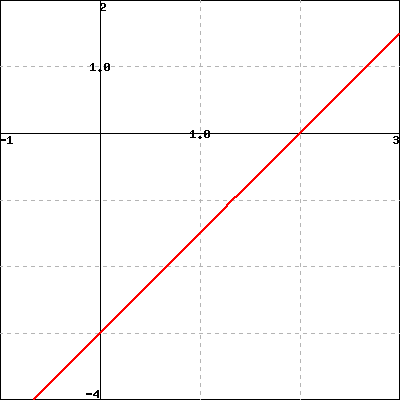
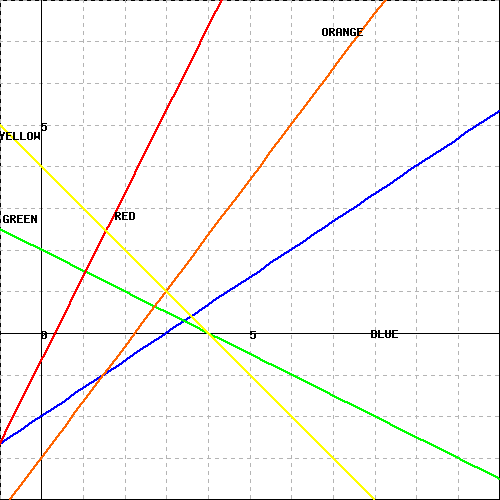
Create a table of values for the rule give using the four numbers supplied for \(x\text{.}\)
Start by entering the values in the second column.
\(x\) \(\frac{2}{3} x -2\)
3
6
9
12
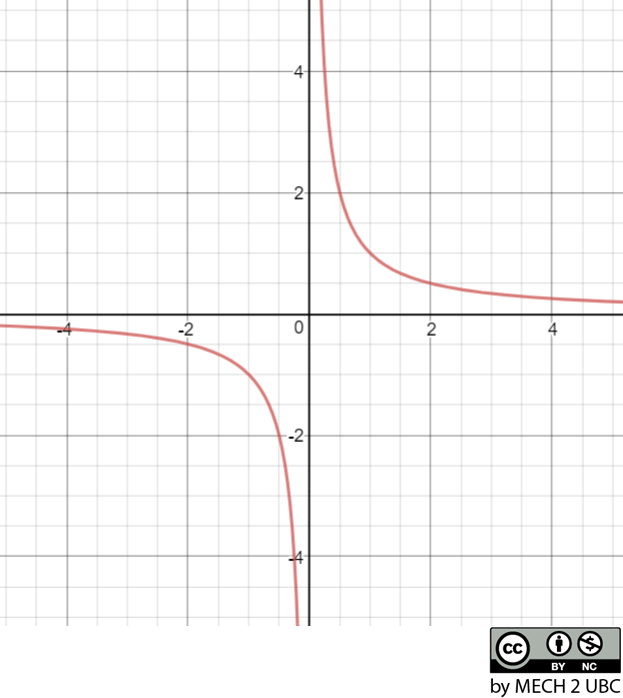
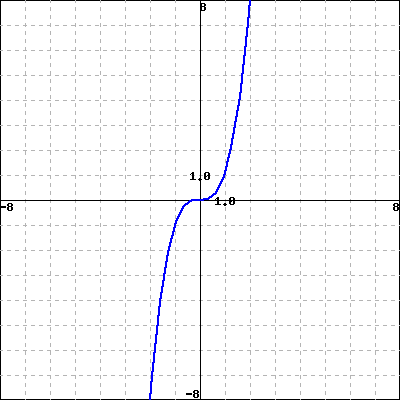
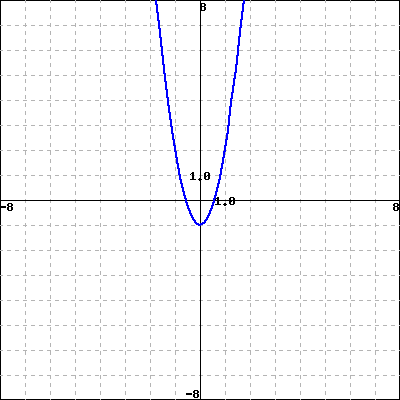
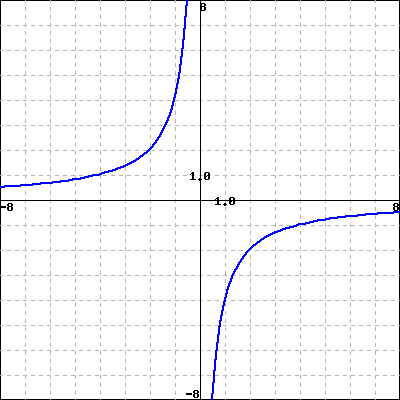
Which color is the graph of the rule in your table?
Answer 1.
Answer 2.
Answer 3.
Answer 4.

5.

Find the \(x\)- and \(y\)-intercepts of the graph of the equation \(y=x^2 + 3 x -28\text{.}\)
The \(x\)-intercept(s) have \(x =\)
Note: If there is more than one, give a comma separated list. If there are none, type none.
The \(y\)-intercept(s) have \(y=\)
Note: If there is more than one, give a comma separated list. If there are none, type none.
Answer 1.
Answer 2.

7.

Use the table of values given below to solve the following exercises.
\(x\) \(y\)
\(-3\) \(-9\)
\(-2\) \(-4\)
\(-1\) \(-1\)
\(0\) \(0\)
\(1\) \(-1\)
\(2\) \(-4\)
\(3\) \(-9\)
a) Which equation corresponds to the points given in the table?
b) Does the graph of the equation pass through the origin? (Enter: Yes or No)
Answer:
c) At which point does the graph of the equation cross the \(x\)-axis?
Answer:
d) At which point does the graph of the equation cross the \(y\)-axis?
Answer:
Answer 1.
Answer 2.
\(\text{Yes}\)
Answer 3.
\(\left(0,0\right)\)

8.

For the graph of the equation \(y=19 x+2\text{,}\) draw a sketch of the graph on a piece of paper. Then answer the following questions:
The \(x\)-intercept is :
The \(y\)-intercept is :
Is the graph symmetric with respect to the \(x\)-axis? Input yes or no here :
Is the graph symmetric with respect to the \(y\)-axis? Input yes or no here :
Is the graph symmetric with respect to the origin? Input yes or no here :
Answer 1.
\(-0.105263157894737\)
Answer 2.
Answer 3.
Answer 4.
Answer 5.

10.

Find the \(x\)- and \(y\)-intercepts of the graph of the equation
\(\displaystyle{x^2+y^2={4}\ }\text{.}\)
  1. The \(x\)-intercepts are: \(\ x_1\) = , \(x_2\) = with \(x_1 \lt x_2\) .
  2. The \(y\)-intercepts are: \(\ y_1\) = , \(y_2\) = with \(y_1 \lt y_2\) .
Answer 1.
Answer 2.
Answer 3.
Answer 4.
Solution.
  1. \(y=0\) everywhere on the \(x\) axis, so plug \(y=0\) into the equation and solve for \(x\) to find the \(x\) intercepts: \(x=-{2}\) and \(x={2}\text{.}\)
  2. \(x=0\) everywhere on the \(y\) axis, so plug \(x=0\) into the equation and solve for \(y\) to find the \(y\) intercepts: \(y=-{2}\) and \(y={2}\text{.}\)

11.

For the graph of the equation \(\displaystyle{\ y=x^4+x^2}\text{,}\) answer the following questions:
  1. Is the graph symmetric with respect to the \(x\)-axis?
  2. Is the graph symmetric with respect to the \(y\)-axis?
  3. Is the graph symmetric with respect to the origin?
Answer 1.
\(\text{No}\)
Answer 2.
\(\text{Yes}\)
Answer 3.
\(\text{No}\)
Solution.
  1. No, the graph is not symmetric about the \(x\)-axis. The point \((1,2)\) is on the graph but its reflection in the \(x\)-axis, \((1,-2)\text{,}\) is not.
  2. Yes, the graph is symmetric about the \(y\)-axis. Replacing \(x\) with \(-x\) in the equation produces an equation \(\displaystyle{y=(-x)^4+(-x)^2=x^4+x^2}\) which is the same as the original equation. Thus \((x,y)\) satisfies the (original) equation if and only if its reflection in the \(y\)-axis \((-x,y)\) satisfies it.
  3. No, the graph is not symmetric about the origin. The point \((1,2)\) is on the graph but its reflection in the origin \((-1,-2)\text{,}\) is not.

12.

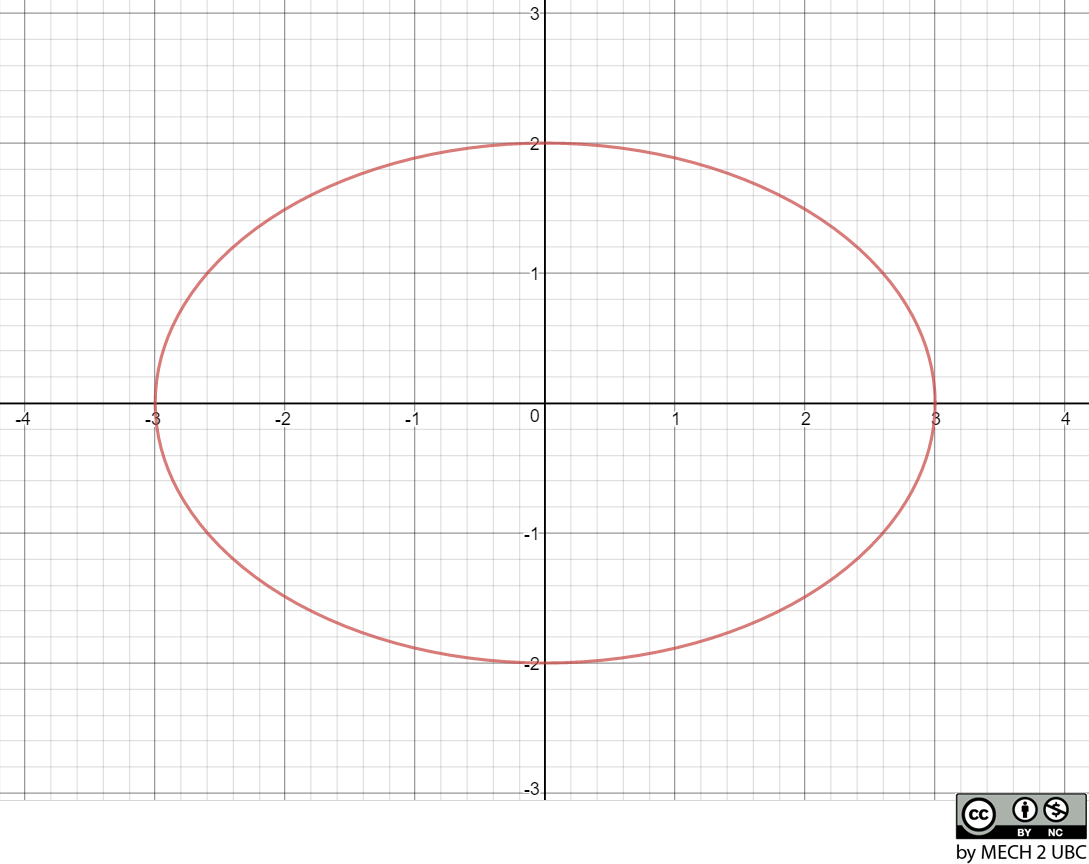
Which equation is graphed in this figure?
  1. \(\displaystyle \displaystyle \frac{x^2}{3} - \frac{y^2}{2} = 1 \)
  2. \(\displaystyle \displaystyle \frac{x^2}{4} + \frac{y^2}{9} = 1 \)
  3. \(\displaystyle \displaystyle \frac{x^2}{9} - \frac{y^2}{4} = 1 \)
  4. \(\displaystyle \displaystyle \frac{x^2}{9} + \frac{y^2}{4} = 1 \)
  5. \(\displaystyle \displaystyle \frac{x^2}{3} + \frac{y^2}{2} = 1 \)
Answer.
\(\text{D}\)