This set of exercises is to help you assess your own algebra background knowledge before beginning Math 111. For more algebra practice resources, as well as links to study and review materials, checkout the complete Reed Math Trailhead.
To add or subtract fractions we need a least common denominator (LCD). For example, \(\frac{2}{5} - 3 = \frac{2}{5} - \frac{3}{1} = \frac{2}{5} - \frac{15}{5} = -\frac{13}{5}\text{.}\)
Checkpoint5.Write a Line from Its Slope and a Point.
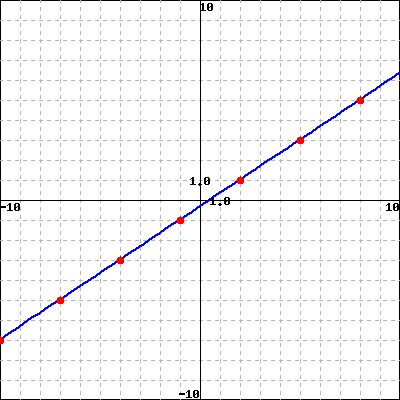
Find an equation of the line with slope \(\displaystyle{{{\frac{1}{3}}} }\) that passes through the point \((4,3)\text{.}\) Write your solution in slope-intercept form.
When trying to find the equation of a line with some information, start with the equation in slope-intercept form, that is, \(y = mx+b\text{.}\) Then substitute in any known information. In this case, we know the slope is \(m={{\frac{1}{3}}}\text{,}\) or
Find the intercepts of \(f(x)={5\mathopen{}\left(x-5\right)\mathopen{}\left(x-2\right)\mathopen{}\left(x-3\right)}\text{.}\) Enter intercepts as points. If you have more than one point, enter them as a comma separated list.
a. This is our reference angle. \({\frac{\pi }{4}}\) is in the first quadrant, where the \(x\)-coordinate (and therefore cosine) is positive.So, \(\cos({\frac{\pi }{4}}) = {\frac{\sqrt{2}}{2}}\text{.}\)
b.\({\frac{3\pi }{4}}\) is in the second quadrant, where the \(x\)-coordinate (and therefore cosine) is negative.So, \(\cos({\frac{3\pi }{4}}) = {-\frac{\sqrt{2}}{2}}\text{.}\)
c.\({\frac{5\pi }{4}}\) is in the third quadrant, where the \(x\)-coordinate (and therefore cosine) is negative.So, \(\cos({\frac{5\pi }{4}}) = {-\frac{\sqrt{2}}{2}}\text{.}\)
d.\({\frac{7\pi }{4}}\) is in the fourth quadrant, where the \(x\)-coordinate (and therefore cosine) is positive.So, \(\cos({\frac{7\pi }{4}}) = {\frac{\sqrt{2}}{2}}\text{.}\)
e.\({\frac{9\pi }{4}}\) is coterminal with \({\frac{\pi }{4}}\text{,}\) and both are in the first quadrant, where the \(x\)-coordinate (and therefore cosine) is positive.So, \(\cos({\frac{9\pi }{4}}) = {\frac{\sqrt{2}}{2}}\text{.}\)
f.\({\frac{-3\pi }{4}}\) is coterminal with \({\frac{5\pi }{4}}\text{,}\) and both are in the third quadrant, where the \(x\)-coordinate (and therefore cosine) is negative.So, \(\cos({\frac{-3\pi }{4}}) = {-\frac{\sqrt{2}}{2}}\text{.}\)
g.\({\frac{-5\pi }{4}}\) is coterminal with \({\frac{3\pi }{4}}\text{,}\) and both are in the second quadrant, where the \(x\)-coordinate (and therefore cosine) is negative.So, \(\cos({\frac{-5\pi }{4}}) = {-\frac{\sqrt{2}}{2}}\text{.}\)
h.\({\frac{-7\pi }{4}}\) is coterminal with \({\frac{\pi }{4}}\text{,}\) and both are in the first quadrant, where the \(x\)-coordinate (and therefore cosine) is positive.So, \(\cos({\frac{-7\pi }{4}}) = {\frac{\sqrt{2}}{2}}\text{.}\)