
Math Trailhead

Section Stat 141

This set of exercises is to help you assess your own algebra background knowledge before beginning Stat 141. For more algebra practice resources, as well as links to study and review materials, checkout the complete Reed Math Trailhead.

Subsection Quantitative Reasoning

Percentages and Proportions

Checkpoint 17. Calculate a Percentage of a Quantity.

In last season’s basketball games, Kandace made \(30\%\) in free throws. If he attempted a total of \(270\) free throws, how many free throws did she make?
Kandace made free throws last season.
Answer.
Solution.
This problem can be boiled down to this question: What is \(30\%\) of \(270\text{?}\) We will show multiple methods to solve this problem.
Method 1
We will use proportion to solve this problem. Assume \(30\%\) of \(270\) is \(x\text{,}\) so β€œ\(30\) out of \(100\)” corresponds to β€œ\(x\) out of \(270\)”.
We will write and solve the proportion:
\(\displaystyle{\begin{aligned}[t] \frac{30}{100} \amp = \frac{x}{270} \\ 100x \amp = 30 \cdot 270 \\ 100x \amp = 8100 \\ \frac{100x}{100} \amp = \frac{8100}{100} \\ x \amp = 81 \end{aligned} }\)
Kandace made \(81\) free throws last season.
Method 2
We will use the percentage formula to solve this problem. This translation from English to math may help you remember the percentage formula.
\(2 \text{ is } 50\% \text{ of } 4 \iff 2 = 0.5 \cdot 4\)
The question is: What is \(30\%\) of \(270\text{?}\) Assume \(x\) is \(30\%\) of \(270\text{.}\) We have:
\(\displaystyle{ \begin{aligned} x \amp = 0.3 \cdot 270 \\ \amp = 81 \end{aligned} }\)
Kandace made \(81\) free throws last season.
Method 3
In the sentence β€œWhat is \(30\%\) of \(270\text{,}\)”
By the formula \(\text{percentage} = \text{rate} \cdot \text{base}\text{,}\) we do a multiplication to solve the problem:
\(\displaystyle{ \text{percentage } = \text{rate} \cdot \text{base} = 30\% \cdot 270 = 0.3 \cdot 270 = 81 }\)
Kandace made \(81\) free throws last season.

Checkpoint 18. Solve a Proportion with an Unknown Numerator.

Checkpoint 19. Solve a Proportion with an Unknown Denominator.

Tables and Summary Statistics

Checkpoint 20. Convert Among Percents, Fractions, and Decimals.

Complete the table of values.
Percent Fraction Decimal
\(40\) \(2/5\) \(.4\)
\(2\)
6/25
\(1.21\)
Answer 1.
\({\frac{1}{50}}\)
Answer 2.
\(0.02\)
Answer 3.
Answer 4.
\(0.24\)
Answer 5.
Answer 6.
\({\frac{121}{100}}\)
Solution.
Row 1 To convert a percent into a fraction, divide it by 100 and reduce.
\(2\% = \frac{2}{100} = {{\frac{1}{50}}}\)
To convert a percent into a decimal, move the decimal two places to the left.
\(2\% = {0.02}\)
Row 2 To convert a fraction into a percent, we can set up the proportion:
\({{\frac{6}{25}}} = \frac{p}{100}\)
\(p = {{\frac{6}{25}}} \cdot 100 = {24}\%\)
Now we can convert the percent to a decimal by moving the decimal two places to the left.
\({24}\% = {0.24}\)
Row 3 To convert a decimal to a percent, move the decimal two places to the right.
\(1.21 = {121}\%\)
Put the percent over 100 (and reduce) to convert it to a fraction.
\(\frac{{121}}{100} = {{\frac{121}{100}}}\)
Summary
\(2\% = {{\frac{1}{50}}} = {0.02}\)
\({24}\% = {{\frac{6}{25}}} = {0.24}\)
\({121}\% = {{\frac{121}{100}}} = 1.21\)

Checkpoint 21. Calculate the Mean and Median.

Find the mean and median of this group of numbers:
\(\displaystyle{ 6,\;\;1,\;\;6,\;\;14,\;\;18 }\)
  1. The mean of this list of numbers is .
  2. The median of this list of numbers is .
Answer 1.
Answer 2.
Solution.
Find the mean
To find the mean of a group of numbers, we first add up all numbers and find their sum:
\(\displaystyle{ \text{sum} = 6+1+6+14+18 = 45 }\)
Next, we divide the sum by how many numbers there are:
\(\displaystyle{ \text{mean} = \frac{45}{5} = 9 }\)
The mean of this group of numbers is \(9\text{.}\)
Find the median
To find the median of a list of number, we first need to order these numbers from smallest to largest:
\(\displaystyle{ 1,\;\;6,\;\;6,\;\;14,\;\;18 }\)
The number in the middle is the median.
The median of this group of numbers is \(6\text{.}\)

Subsection Algebraic Foundations

Fractions and Fractional Expressions

Checkpoint 22. Add and Simplify Fractions.

Add the fractions, and reduce your answer.
\begin{equation*} \frac{8}{8}+\frac{11}{5} \end{equation*}
The reduced answer is
Answer.
\(3{\textstyle\frac{1}{5}}\)

Checkpoint 23. Evaluate Expressions with Fractional Inputs.

Evaluate each expression if \(a=-{\frac{1}{5}},\ b={\frac{3}{5}},\ c= -2 \frac{1}{4},\ d=4\frac{1}{3}\text{.}\)
Your answer should be a reduced fraction or a mixed number.
a) \(4a=\)
b) \(a+cd=\)
c) \(9d+\frac{7}{8}=\)
d) \(d(b+6)=\)
Answer 1.
\(-{\frac{4}{5}}\)
Answer 2.
\(-9{\textstyle\frac{19}{20}}\)
Answer 3.
\(39{\textstyle\frac{7}{8}}\)
Answer 4.
\(28{\textstyle\frac{3}{5}}\)
Solution.
Solution
a) \(4a=4\times -{\frac{1}{5}}=-{\frac{4}{5}}\)
b) \(a+cd= -{\frac{1}{5}} - 2{\textstyle\frac{1}{4}}\times 4{\textstyle\frac{1}{3}}= -9{\textstyle\frac{19}{20}}\)
c) \(9d+\frac{7}{8}=\(9\times 4{\textstyle\frac{1}{3}}+\frac{7}{8} = 39{\textstyle\frac{7}{8}}\)
d) \(d(b+6)=4{\textstyle\frac{1}{3}}({\frac{3}{5}}+6) = 28{\textstyle\frac{3}{5}}\)
Linear Equations and Graphs

Checkpoint 24. Find a Line’s Slope and Vertical Intercept.

A line has the equation \(\displaystyle{ -{7}x+y= 6 }\text{.}\) Find this line’s slope and \(y\)-intercept. If either of these do not exist, you may enter DNE or NONE.
This line’s slope is .
This line’s \(y\)-intercept is .
Answer 1.
Answer 2.
\(\left(0,6\right)\)
Solution.
When an equation of a line is written in the form \(y=mx+b\text{,}\) it is said to be in slope-intercept form. In this form, \(m\) is the line’s slope, and \(b\) is the coordinate on the \(y\)-axis where the line intercepts the \(y\)-axis.
In this problem, the line’s equation is given as \(\displaystyle{ -{7}x+y= 6 }\text{.}\) It would be helpful to algebraically rearrange this into slope-intercept form: \(y= mx+b\text{.}\)
\(\displaystyle{\begin{aligned} -{7}x+y \amp = 6 \\ -{7}x+y\mathbf{{}+{7}x} \amp = 6\mathbf{{}+{7}x} \\ y \amp = {7}x+6 \end{aligned} }\)
Now we can see the line’s slope is \({7}\text{,}\) and its \(y\)-intercept has coordinates \((0,6)\text{.}\)

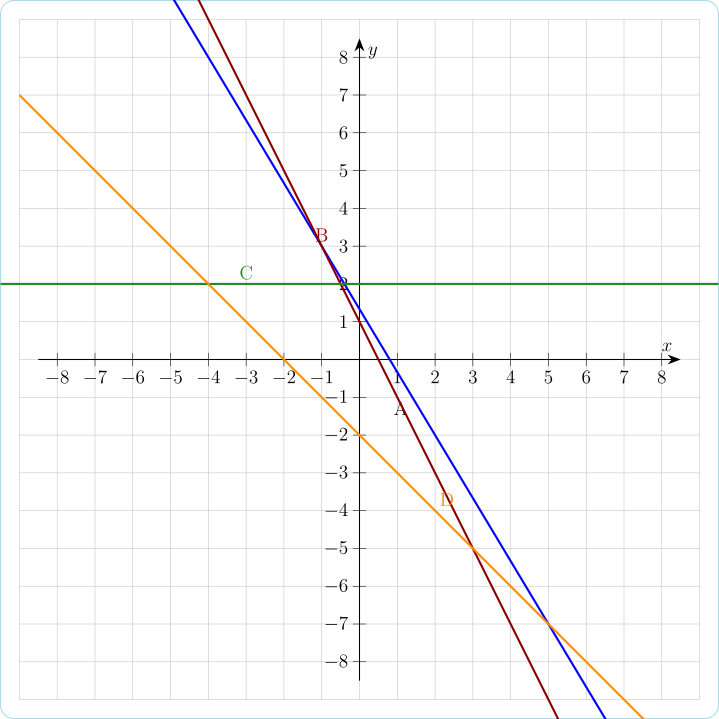
Checkpoint 25. Match Linear Equations to Their Graphs.

A graph of four lines.  Line A passes through the points ((4/5),0) and (0,(4/3)).  Line B has slope -2 and y-intercept 1. Line C is horizontal and has y-intercept of 2.  Line D has intercepts ((-2),0) and (0, (-2))
Identify the graphs of the lines by letter:
Answer 1.
\(\text{C}\)
Answer 2.
\(\text{B}\)
Answer 3.
\(\text{D}\)
Answer 4.
\(\text{A}\)
Solution.
For each of the lines in the answer, you should identify if the line is vertical, horizontal or oblique.
In this case, the line \({5x+3y = 4}\) is horizontal. The answer is C.
The line \({2x+y = 1}\) in slope-intercept form, and the slope is -2 with y-intercept of 1. It appears that the line has this slope and y-intercept. The answer is B.
For the other two lines, they are nearly in intercept form, so we should do that. The line \({y = 2}\) is:
\begin{equation*} \begin{eqnarray} 5 x + 3 y \amp = 4 \\ \frac{5}{4} x + \frac{3}{4} y \amp = 1 \\ \frac{x}{{{\frac{4}{5}}}} + \frac{y}{{{\frac{4}{3}}}} \amp = 1 \end{eqnarray} \end{equation*}
so the x-intercept is \({{\frac{4}{5}}}\) and the y-intercept is \({{\frac{4}{3}}}\text{.}\) The answer is D.
We could just use process of elimination to find the last line, but lets repeat the process above. The last line is
\begin{equation*} \begin{eqnarray} 4 x + 4 y \amp = -8 \\ \frac{4}{-8} x + \frac{4}{-8} y \amp = 1 \\ \frac{x}{{-2}} + \frac{y}{{-2}} \amp = 1 \end{eqnarray} \end{equation*}
so the x-intercept is -8/4 and the y-intercept is -8/4. The answer is A.

Checkpoint 26. Interpret a Linear Profit Model.

The equation below shows the profit \(p\) from selling \(n\) cups of lemonade
\(p=2n-10\)
Whice of the following best describes the relationship between \(n\) and \(p\)
Solution.
Solution
The best way to handle this problem, if the answer is not immediately clear to you,
is to add a positive quantity to \(n\) and see what happens to \(p\text{.}\)
Suppose \(m\) is positive and we repace \(n\) by \(n+m\text{.}\) Calling the resulting value
of \(p\) by the name \(p'\) we obtain the equation
\(p'=2(n+m)-10=2n-10+2m\text{.}\)
This tells us that when we increase \(n\) by \(m\) we increase \(p\) by \(2m\text{.}\)

Subsection Functions and Modeling

Evaluating and Interpreting Functions

Checkpoint 27. Interpret a Cost Function.

The daily cost to the printing company to print a book is modeled by the function \(C(x) = {4x+1700}\) where \(C\) is the total daily cost and \(x\) is the number of books printed. Find the following and explain what each result means:
\(C(0) =\)
\(C(500) =\)
Explain your results by writing two sentences: one to explain what \(C(0)\) is telling you and the other to explain what \(C(500)\) is telling you:
Answer 1.
\(1700\)
Answer 2.
\(4\cdot 500+1700\)

Checkpoint 28. Evaluate a Function at Numeric and Symbolic Inputs.

Evaluate \(f(x)={2x^{2}-3}\) at the following values:
Answer 1.
Answer 2.
Answer 3.
\(2a^{2}-3\)
Answer 4.
\(18a^{2}-3\)
Answer 5.
\(2\mathopen{}\left(a+3\right)^{2}-3\)
Solution.
\(=2(-3)^2 - 3\)
\(=2 \cdot 9 - 3\)
\(= {15}\)
\(=2(4)^2 - 3\)
\(=2 \cdot 16 - 3\)
\(= {29}\)
\(={2a^{2}-3}\)
\(2(3a)^2 - 3\)
\(2\cdot 9a^2 - 3\)
\({18a^{2}-3}\)
\(2(a + 3)^2 - 3\)
\(2({a^{2}+6a+9}) - 3\)
\({2a^{2}+12a+18} - 3\)
\({2a^{2}+12a+15}\)

Checkpoint 29. Evaluate a Quadratic Function.

Evaluate \(f(x)={-2x^{2}-10x}\) at the following values:
Answer 1.
Answer 2.
Answer 3.
\(-2p^{2}-10p\)
Solution.
\(=-2(-5)^2 - 10(-5)\)
\(=-2 \cdot 25 - 10(-5)\)
\(= {0}\)
\(=-2(4)^2 - 10(4)\)
\(=-2 \cdot 16 - 10(4)\)
\(= {-72}\)
\(={-2p^{2}-10p}\)
Modeling in Context

Checkpoint 30. Interpret a Function in Context.

Kristen started saving in a piggy bank on her birthday. The function \(f(x)={4x+1}\) models the amount of money, in dollars, in Kristen’s piggy bank. The independent variable represents the number of days passed since her birthday.
Interpret the meaning of \(f(2)=9\text{.}\)
  1. A. The piggy bank started with `$2` in it, and Kristen saves `$9` each day.
  2. B. Two days after Kristen started her piggy bank, there were `$9` in it.
  3. C. The piggy bank started with `$9` in it, and Kristen saves `$2` each day.
  4. D. Nine days after Kristen started her piggy bank, there were `$2` in it.
Hint.
For \(f(x)={4x+1}\text{,}\) what does the value of \(x\) respresent?
What does the value of \(f(x)\) represent?
What are the units of \(x\text{?}\)
What are the units of \(f(x)\text{?}\)
Answer.
\(\text{B}\)
Solution.
For \(f(x)={4x+1}\text{,}\) the value of \(x\) represents the number of days passed since Kristen’s birthday, and the value of \(f(x)\) represents the amount of money in the piggy bank.
It’s helpful to understand those values by units: \(x\) is in β€œdays,” while \(f(x)\) is in β€œdollars.”
For \(f(2)=9\text{,}\) \(2\) represents \(2\) days, while \(9\) represents \(9\) dollars. The correct solution is: B. Two days after Kristen started her piggy bank, there were `$9` in it.

Subsection Polynomial Expressions

Simplifying Polynomials

Checkpoint 31. Expand and Simplify a Polynomial Expression.
