Math Trailhead

Worksheet Functions

1.

Find the domain and range of \(f(x)={4x-6}\text{.}\) Enter your solution in interval notation.
Domain:
Range:
Answer 1.
\(\left(-\infty ,\infty \right)\)
Answer 2.
\(\left(-\infty ,\infty \right)\)
Solution.
To find the domain of a function, think about the following:
  • Is it a rational function (algebraic fraction)? If so, the denominator can’t equal zero.
  • Is it a square root function (or maybe another even-root)? If so, the radicand (thing under the square root) must be greater than or equal to zero.
  • Is it a polynomial? Absolute value function? Exponential function? If so, the domain is all real numbers.
This is a linear function--it we were to graph it, we would see a line that continues in both directions. That makes both the domain and range \({\left(-\infty ,\infty \right)}\text{.}\)
2.

Find the domain of \(f(x)={\left|3x+4\right|}\text{.}\) Enter your solution in interval notation.
Answer.
\(\left(-\infty ,\infty \right)\)
Solution.
To find the domain of a function, think about the following:
  • Is it a rational function (algebraic fraction)? If so, the denominator can’t equal zero.
  • Is it a square root function (or maybe another even-root)? If so, the radicand (thing under the square root) must be greater than or equal to zero.
  • Is it a polynomial? Absolute value function? Exponential function? If so, the domain is all real numbers.
This is an absolute value function. We can plug anything into absolute value functions, so the domain is \({\left(-\infty ,\infty \right)}\text{.}\)
3.

Find the domain of \(f(x)={\sqrt{10-6x}}\text{.}\) Enter the solution in interval notation.
Answer.
\(\left(-\infty ,1.66667\right]\)

4.

Find the domain of \(\displaystyle{ f(x)={\frac{x+2}{3x+1}} }\text{.}\) Enter the solution in interval notation.
Answer.
\(\left(-\infty ,-0.333333\right)\cup \left(-0.333333,\infty \right)\)

5.

Find the domain of \(\displaystyle{ f(x)={\frac{x+7}{x^{2}-7x-18}} }\text{.}\) Enter the solution in interval notation.
Answer.
\(\left(-\infty ,-2\right)\cup \left(-2,9\right)\cup \left(9,\infty \right)\)

9.

Every day a new puzzle is downloaded into Ken’s account. Right now, he has \(38\) puzzles in his account. The function \(N(t) = 38 + t\) represents the relation between the number of puzzles, \(N\) and time, \(t\text{,}\) measured in days. Find \(N(33)\) and explain what this result means.
\(N(33) =\)
This result gives:
Answer 1.
Answer 2.
\(\text{Choice 3}\)

10.

The daily cost to the printing company to print a book is modeled by the function \(C(x) = {3.5x+1100}\) where \(C\) is the total daily cost and \(x\) is the number of books printed. Find the following and explain what each result means:
\(C(0) =\)
\(C(2500) =\)
Explain your results by writing two sentences: one to explain what \(C(0)\) is telling you and the other to explain what \(C(2500)\) is telling you:
Answer 1.
\(1100\)
Answer 2.
\(3.5\cdot 2500+1100\)

11.

Evaluate \(f(x)={5x^{2}+5}\) at the following values:
Answer 1.
Answer 2.
Answer 3.
\(5a^{2}+5\)
Answer 4.
\(20a^{2}+5\)
Answer 5.
\(5\mathopen{}\left(a+2\right)^{2}+5\)
Solution.
\(=5(-5)^2 + 5\)
\(=5 \cdot 25 + 5\)
\(= {130}\)
\(=5(3)^2 + 5\)
\(=5 \cdot 9 + 5\)
\(= {50}\)
\(={5a^{2}+5}\)
\(5(2a)^2 + 5\)
\(5\cdot 4a^2 + 5\)
\({20a^{2}+5}\)
\(5(a + 2)^2 + 5\)
\(5({a^{2}+4a+4}) + 5\)
\({5a^{2}+20a+20} + 5\)
\({5a^{2}+20a+25}\)

12.

Evaluate \(f(x)={-5x^{2}-2x}\) at the following values:
Answer 1.
Answer 2.
Answer 3.
\(-5p^{2}-2p\)
Solution.
\(=-5(-1)^2 - 2(-1)\)
\(=-5 \cdot 1 - 2(-1)\)
\(= {-3}\)
\(=-5(3)^2 - 2(3)\)
\(=-5 \cdot 9 - 2(3)\)
\(= {-51}\)
\(={-5p^{2}-2p}\)

13.

Evaluate \(f(x)={2x-9}\) at each of the following values. Be sure to simplify your answer completely.
\(f(-1)=\)
\(f(4)=\)
\(f(a)=\)
\(f(a+h)=\)
\(f(-a)=\)
\(-f(a)=\)
Hint.
If the function is \(f(x)\text{,}\) then \(f(4)\) means that \(x\) is replaced with \(4\text{.}\)
Therefore, if \(f(x) = 2x+1\text{,}\) then \(f(2) = 2(2)+1 = 5\)
Answer 1.
Answer 2.
Answer 3.
\(2a+-9\)
Answer 4.
\(2a+2h-9\)
Answer 5.
\(-2a-9\)
Answer 6.
\(-2a--9\)

14.

Evaluate \(f(x)={\sqrt{3-x}+4}\) at each of the following values:
Answer 1.
\(6.82843\)
Answer 2.
Answer 3.
\(\sqrt{3-a}+4\)
Answer 4.
\(\sqrt{3-\left(a+h\right)}+4\)
Answer 5.
\(\sqrt{3+a}+4\)
Answer 6.
\(-\sqrt{3-a}-4\)

15.

Evaluate \(f(x)={\left|x-3\right|-\left|x+4\right|}\) at each of the following values:
Answer 1.
Answer 2.
Answer 3.
\(\left|a-3\right|-\left|a+4\right|\)
Answer 4.
\(\left|a+h-3\right|-\left|a+h+4\right|\)
Answer 5.
\(\left|-a-3\right|-\left|-a+4\right|\)
Answer 6.
\(-\left|a-3\right|+\left|a+4\right|\)

16.

Let \(f(x) = {-4+5x}\text{.}\)
Evaluate \(f(-3)=\)
Solve \(f(x)=2\text{.}\)
Hint.
If \(f(x) = 12x+7\) and you wish to solve \(f(x)=-7\) then you should set the function equal to \(-7\) and solve for \(x\text{.}\)
\(\displaystyle{\begin{aligned} 12x+7 \amp =-7 \\ 12x \amp =-14 \\ x \amp =\frac{-14}{12}\\ x\amp =\frac{-7}{6} \end{aligned} }\)
Answer 1.
Answer 2.

18.

Let \(f(x) = {x^{2}+2x}\) and \(g(x) = {3-x^{2}}\text{.}\)
If the video does not work, click here to watch on YouTube.
Answer 1.
\(2x+3\)
Answer 2.
\(2x^{2}+2x-3\)
Answer 3.
\(-x^{4}-2x^{3}+3x^{2}+6x\)
Answer 4.
\(\frac{x^{2}+2x}{3-x^{2}}\)
Answer 5.
\(\left(-\infty ,\infty \right)\)
Answer 6.
\(\left(-\infty ,\infty \right)\)
Answer 7.
\(\left(-\infty ,\infty \right)\)
Answer 8.
\(\left(-\infty ,-\sqrt{3}\right)\cup \left(-\sqrt{3},\sqrt{3}\right)\cup \left(\sqrt{3},\infty \right)\)

19.

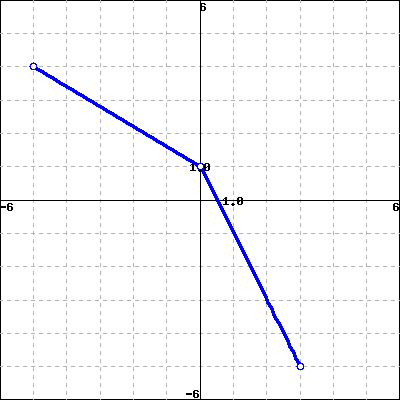
Fill in the blanks to describe the given piecewise graph. (Note: Enter your answers with the function in the left blank and the \(x\) intervals for the second two blanks. Be sure the first line is the function with the smallest \(x\) values and the second line is the function with the largest \(x\) values.)
\(\displaystyle f(x) = \Bigg\{ \; \) \(\displaystyle for \) \(\displaystyle for \) \( < x < \) \( < x < \)
If the video does not work, click here to watch on YouTube.
Answer 1.
\(-0.6\mathopen{}\left(x+5\right)+4\)
Answer 2.
\(-2\mathopen{}\left(x-0\right)+1\)
Answer 3.
Answer 4.
Answer 5.
Answer 6.

20.

Given the piecewise function, find the function values.
\(f(x)={\begin{cases}\displaystyle{8x-2}\amp \text{if}\ x \lt 2\cr \displaystyle{9-4x}\amp \text{if}\ x \ge 2\end{cases}}\)
\(f(-1)=\)
\(f(0)=\)
\(f(2)=\)
\(f(5)=\)
Hint.
First find which part of the piecewise function the desired `x`-value is part of, then use that piece to evaluate the function value.
Answer 1.
Answer 2.
Answer 3.
Answer 4.

21.

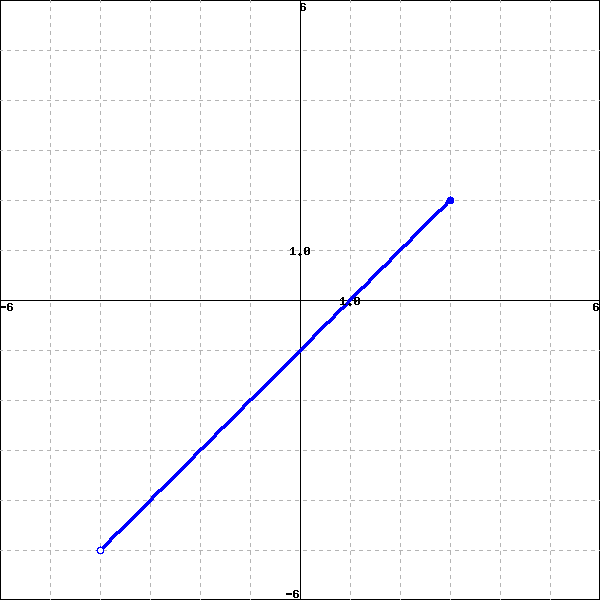
Graph the piecewise function to find the domain and range. Give the answers in interval notation.
\(f(x)={\begin{cases}\displaystyle{3x-2}\amp \text{if}\ x \le 0\cr \displaystyle{x+2}\amp \text{if}\ x > 0\end{cases}}\)
Domain:
Range:
If the video does not work, click here to watch on YouTube.
Answer 1.
\(\left(-\infty ,\infty \right)\)
Answer 2.
\(\left(-\infty ,-2\right]\cup \left(2,\infty \right)\)

22.

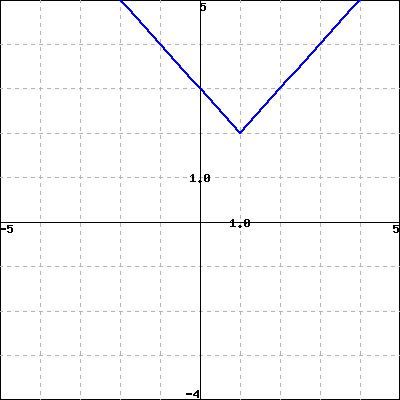
Find the intervals where the function \(y=f(x)\text{,}\) whose graph is given below, is increasing and where it is decreasing and find the value of the absolute minimum.
(Click on graph to enlarge)
Increasing:
Decreasing:
Absolute minimum:
Hint.
A function \(f\) is an increasing function on an open interval if \(f(b)>f(a)\) for any two input values \(a\) and \(b\) in the given interval where \(b>a\text{.}\)
A function \(f\) is a decreasing function on an open interval if \(f(b)\lt f(a)\) for any two input values \(a\) and \(b\) in the given interval where \(b>a\text{.}\)
A function \(f\) has a local maximum at \(x=b\) and the local maximum is \(y=f(b)\) if there exists an interval \((a,c)\) with \(a\lt b\lt c\) such that, for any \(x\) in the interval \((a,c)\text{,}\) \(f(x)\lt f(b)\text{.}\)
Likewise, \(f\) has a local minimum at \(x=b\) and the local minimum is \(y=f(b)\) if there exists an interval \((a,c)\) with \(a\lt b\lt c\) such that, for any \(x\) in the interval \((a,c)\text{,}\) \(f(x)>f(b)\text{.}\)
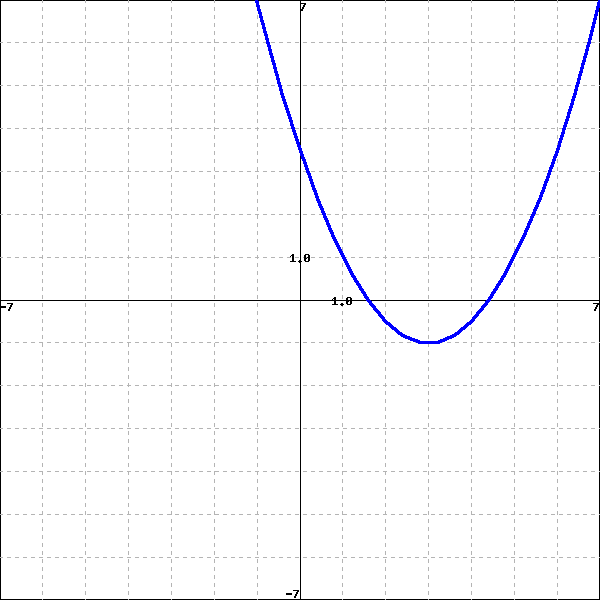
For example, the function \(f(x)\text{,}\) graphed below, is increasing on the interval \((3,\infty)\text{,}\) decreasing on the interval \((-\infty, 3)\text{,}\) and has an absolute minimum at \(x=3\) and the absolute minimum is \(y=-1\text{.}\)
Answer 1.
\(\left(1,\infty \right)\)
Answer 2.
\(\left(-\infty ,1\right)\)
Answer 3.
\(\text{y=}\)
Answer 4.