Math Trailhead

Worksheet Polynomial Roots

1.

Find the intercepts of \(f(x)={2\mathopen{}\left(x-2\right)\mathopen{}\left(x+5\right)\mathopen{}\left(x-5\right)}\text{.}\) Enter intercepts as points. If you have more than one point, enter them as a comma separated list.
Answer 1.
\(\left(0,100\right)\)
Answer 2.
\(\left(2,0\right), \left(-5,0\right), \left(5,0\right)\)

3.

Find the \(x\)-intercept(s) of \(f(x)={x^{3}+5x^{2}-9x-45}\text{.}\) Enter intercept(s) as points. If there is more than one point, enter them as a comma separated list. (Hint: this involves factor by grouping)
Answer.
\(\left(-5,0\right), \left(3,0\right), \left(-3,0\right)\)

4.

Find the \(x\)-intercept(s) of \(f(x)={3x^{4}-3x^{2}-36}\text{.}\) Enter intercept(s) as points. If there is more than one point, enter them as a comma separated list. (Hint: this involves ā€œuā€ substitution)
Answer.
\(\left(2,0\right), \left(-2,0\right)\)

5.

Find the \(x\)-intercept(s) of \(f(x)={x^{5}-3x^{3}+2x}\text{.}\) Enter intercept(s) as points. If there is more than one point, enter them as a comma separated list.
Answer.
\(\left(0,0\right), \left(1,0\right), \left(-1,0\right), \left(1.41421,0\right), \left(-1.41421,0\right)\)

6.

Find the zeros and give the multiplicity of each for \(f(x)={\left(x-3\right)^{2}\mathopen{}\left(x+2\right)^{3}}\text{.}\)
Note: to get the problem correct, you must get all answers correct.
If the video does not work, click here to watch on YouTube.
Answer 1.
Answer 2.
Answer 3.
Answer 4.

7.

Find the zeros and give the multiplicity of each for \(f(x)={x^{3}\mathopen{}\left(x-4\right)^{2}\mathopen{}\left(x+5\right)^{2}}\text{.}\)
Note: to be counted as correct, you must get all answers correct.
Answer 1.
Answer 2.
Answer 3.
Answer 4.
Answer 5.
Answer 6.

8.

Find the zeros and give the multiplicity of each for \(f(x)={x^{6}+3x^{5}-28x^{4}}\text{.}\)
Note: to be counted as correct, you must get all answers correct.
Answer 1.
Answer 2.
Answer 3.
Answer 4.
Answer 5.
Answer 6.

10.

Solve the following linked questions.
(A) Find the polynomial of lowest degree with
\(\quad \bullet\ \ p(-2) = p(0) = p(2) = 0\)
\(\quad \bullet\ \ p(1) = -4\)
\(\quad p(x) =\)
(B) Find the polynomial of lowest degree with
\(\quad \bullet\ \ p(-2) = p(0) = p(2) = -2\)
\(\quad \bullet\ \ p(1) = -4\)
\(\quad p(x) =\)
(It is not necessary to expand and simplify your answers.)
Answer 1.
\(\frac{4}{3}\mathopen{}\left(x-2\right)x\mathopen{}\left(x+2\right)\)
Answer 2.
\(\frac{2}{3}\mathopen{}\left(x-2\right)x\mathopen{}\left(x+2\right)-2\)

11.

Solve the following linked questions.
(A) Find the polynomial of lowest degree with
\(\quad \bullet\ \ p(x) \le 0\) for all \(x\)
\(\quad \bullet\ \ p(-2) = p(2) = 0\)
\(\quad \bullet\ \ p(-3) = -1\)
\(\quad p(x) =\)
(B) Find the polynomial of lowest degree with
\(\quad \bullet\ \ p(x) \le -3\) for all \(x\)
\(\quad \bullet\ \ p(-2) = p(2) = -3\)
\(\quad \bullet\ \ p(-3) = -7\)
\(\quad p(x) =\)
(It is not necessary to expand and simplify your answers.)
Answer 1.
\(\frac{-1}{25}\mathopen{}\left(x-2\right)^{2}\mathopen{}\left(x+2\right)^{2}\)
Answer 2.
\(\frac{-4}{25}\mathopen{}\left(x-2\right)^{2}\mathopen{}\left(x+2\right)^{2}-3\)

12.

Find the zeros and give the multiplicity of each for \(f(x)={\left(x-8\right)^{4}\mathopen{}\left(x+3\right)^{2}}\text{.}\)
Note: to get the problem correct, you must get all answers correct.
Answer 1.
Answer 2.
Answer 3.
Answer 4.

13.

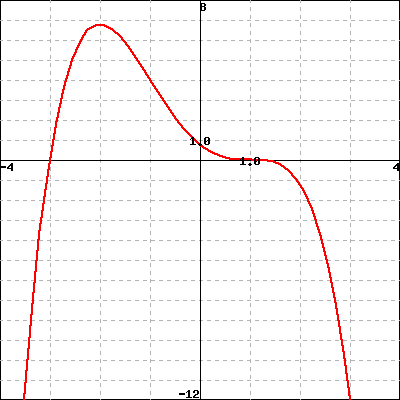
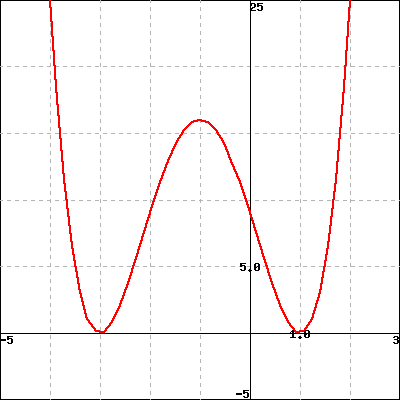
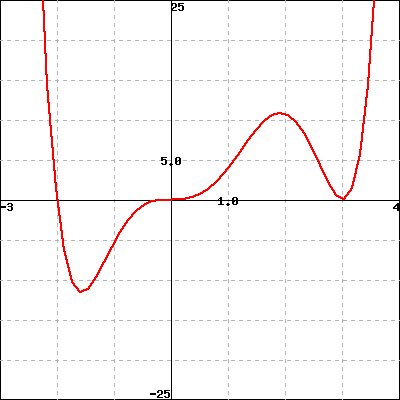
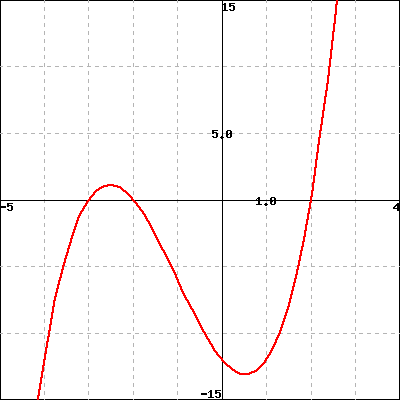
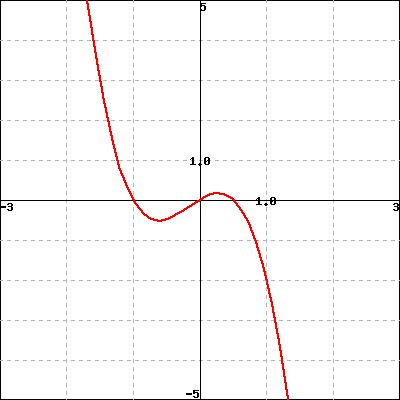
Graph each of the polynomials listed below. Make sure your graph shows all intercepts and exhibits proper end behavior. Then enter the letter corresponding to the correct graph next to each formula for \(P(x)\text{.}\)
  1. \(\displaystyle P(x) = \frac{-1}{4}(x-1)^3(x+3)\)
  2. \(\displaystyle P(x) = \frac13x^3(x+2)(x-3)^2\)
  3. \(\displaystyle P(x) = x^3+3 x^2 - 4 x - 12\)
  4. \(\displaystyle P(x) = -2 x^3- x^2+ x\)
  5. \(\displaystyle P(x) = (x^2+2 x-3)^2\)

15.

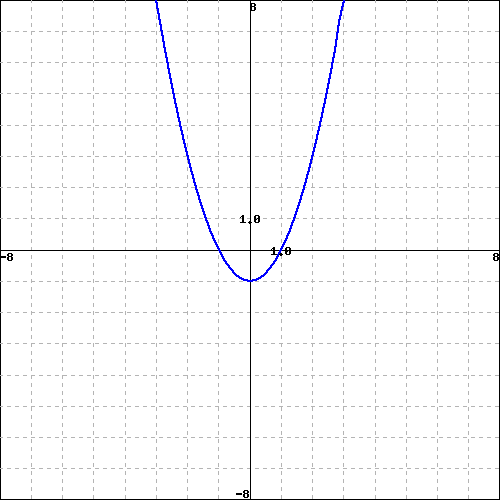
The graph below is a polynomial function in the form \(f(x) = (x-a)(x-b).\) Find suitable real numbers \(a\) and \(b\) that describe the graph.
Answers: \(a =\) and \(b =\)
Note: You can click on the graph to enlarge the image.
Answer 1.
Answer 2.

16.

Given \(f(x) = (x + 4)(x + 1)(x-6)\text{,}\) find the roots in increasing order.
The roots are , , and .
To the left of the first root, is the graph of \(f(x)\) above or below the x-axis? Answer above or below: .
Between the first two roots, is the graph of \(f(x)\) above or below the x-axis? Answer above or below: .
Between the last two roots, is the graph of \(f(x)\) above or below the x-axis? Answer above or below: .
After the last root, is the graph of \(f(x)\) above or below the x-axis? Answer above or below:
Answer 1.
Answer 2.
Answer 3.
Answer 4.
Answer 5.
Answer 6.
Answer 7.