Math Trailhead

Worksheet Systems of Equations

1.

Without graphing, determine the number of solutions in each system.
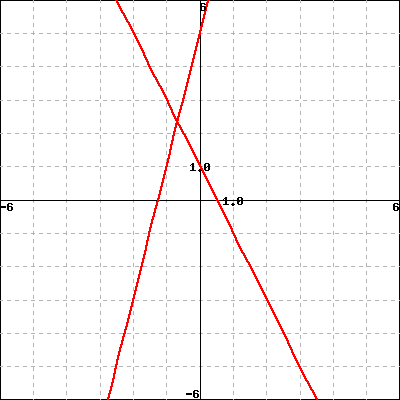
\({-5x-y} = -9\)
\({2y+2x} = 10\)
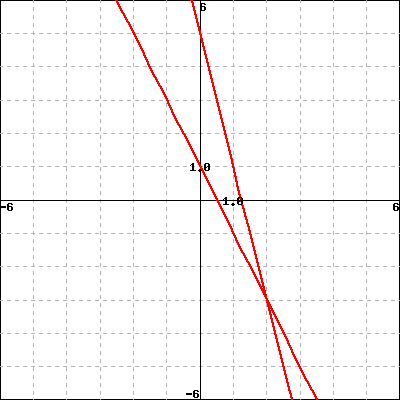
\({-10x+2y} = 3\)
\({30x-6y} = -9\)
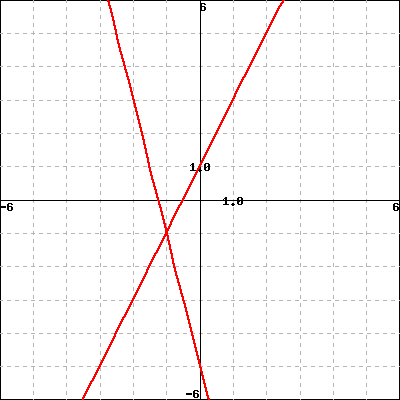
\({3x-y} = 4\)
\({-9x+3y} = 3\)
Answer 1.
\(\text{One}\)
Answer 2.
\(\text{Infinitely Many}\)
Answer 3.
\(\text{None}\)

2.

Solve the system using the substitution method.
\({x-2y} = -16\)
\({-6x-3y} = 21\)
Select the number of solutions. If there is one solution, enter it as a point (a, b), in the answer blank.
Answer 1.
\(\text{There is one solution at}\)
Answer 2.
\(\left(-6,5\right)\)
Solution.
Start by solving the first equation for x:
\(x - 2y = -16\)
\(x = {-16+2y}\)
Then plug that expression into the other equation and solve for y:
\(-6({-16+2y}) - 3y = 21\)
\({96-12y} - 3y = 21\)
\({-15y+96} = 21\)
\({-15}y = {-75}\)
\(y = 5\)
Then we can plug y = 5 into \(x = {-16+2y}\) to solve for x.
\(x = -16 + 2\cdot5 = -6\)
There is one solution at \((-6, 5)\)

3.

Solve the system using the substitution method.
\({4x+6y} = 14\)
\({-2x+y} = -19\)
Select the number of solutions. If there is one solution, enter it as a point (a, b), in the answer blank.
Answer 1.
\(\text{There is one solution at}\)
Answer 2.
\(\left(8,-3\right)\)
Solution.
Solve one equation for one variable. If we solve the first equation for y:
\(6y = 14 - 4x\)
\(y = \frac{14}{6} - \frac{4}{6}x\)
\(y = {{\frac{7}{3}}-{\frac{2}{3}}x}\)
Plug into the second equation:
\(-2x + 1({{\frac{7}{3}}-{\frac{2}{3}}x}) = -19\)
\(-2x + {{\frac{7}{3}}-{\frac{2}{3}}x} = -19\)
\({-\left({\frac{8}{3}}\right)x+{\frac{7}{3}}} = -19\)
\({-{\frac{8}{3}}}x = {-{\frac{64}{3}}}\)
\(x = {-{\frac{64}{3}}} \div {-{\frac{8}{3}}} = 8\)
Plug this into \(y = {{\frac{7}{3}}-{\frac{2}{3}}x}\) to solve for y.
\(y = -3\)
There is one solution at \((8, -3)\)

4.

Solve the system using the substitution method.
\({-2x+y} = -4\)
\({-9x-6y} = 45\)
Select the number of solutions. If there is one solution, enter it as a point (a, b), in the answer blank.
Answer 1.
\(\text{There is one solution at}\)
Answer 2.
\(\left(-1,-6\right)\)
Solution.
Solve one equation for one variable. If we solve the first equation for y:
\(1y = -4 + 2x\)
\(y = \frac{-4}{1} - \frac{-2}{1}x\)
\(y = {-4+2x}\)
Plug into the second equation:
\(-9x - 6({-4+2x}) = 45\)
\(-9x + {24-12x} = 45\)
\({-21x+24} = 45\)
\({-21}x = {21}\)
\(x = {21} \div {-21} = -1\)
Plug this into \(y = {-4+2x}\) to solve for y.
\(y = -6\)
There is one solution at \((-1, -6)\)

5.

Solve the system using the elimination method.
\({x-2y} = 0\)
\({-4x+y} = -14\)
Select the number of solutions. If there is one solution, enter it as a point (a, b), in the answer blank.
Answer 1.
\(\text{There is one solution at}\)
Answer 2.
\(\left(4,2\right)\)

6.

Solve the system using the elimination method.
\(\displaystyle{ {-{\frac{7}{2}}}x+{-{\frac{5}{2}}}y = {-24} }\)
\({-3x-6y} = -9\)
Select the number of solutions. If there is one solution, enter it as a point (a, b), in the answer blank.
Answer 1.
\(\text{There is one solution at}\)
Answer 2.
\(\left(9,-3\right)\)

8.

The Jones family took a \(27\) mile canoe ride down the Indian river in two hours. After lunch the return trip back up the river took three hours. Find the rate of the canoe in still water and the rate of the current.
Rate of the canoe in still water: mph
Rate of the current: mph
Answer 1.
Answer 2.
Solution.
x = rate of the canoe in still water
y = the rate of the current
When the boat is traveling with the current, its net speed is: x + y
When it is traveling against the curent, its net speed is: x - y
Going with the current (downstream) 27 miles was traveled in two hours. Since D = RT:
\(27 = (x + y) \cdot 2\)
Going against the current (upstream) 27 miles was traveled in three hours.
\(27 = (x - y) \cdot 3\)
The equations are:
\(2x + 2y = 27\)
\(3x - 3y = 27\)
Multiply the first equation by 3 and the seocnd equation by 2:
\(6x - 6y = 81\)
\(6x - 6y = 54\)
\(12x = 135\)
\(x = 11.25\)
Plug this into any equation to get \(y = 2.25\text{.}\)
The canoe is moving at 11.25 mph in still water and the current is moving at 2.25 mph.

9.

Sarah left Minneapolis heading east on the interstate at a speed of \(50\) mph. Her sister followed her on the same route, leaving \(3\) hours later and driving at a rate of \(61\) mph. How long will it take for Sarah’s sister to catch up to Sarah? (Round to the nearest tenth.)
Time needed to catch up: hours
Answer.
\(13.6364\)
Solution.
Use the fact that Distance = Rate x Time to set up equations for this problem.
D = distance traveled when the sister catches up
T = time it takes her sister to catch up
Sarah has been driving for 3 hours longer than her sister--she started the trip earlier. She has traveled \(D\) miles in \(T + 3\) hours.
\(D = 50(T + 3)\)
Sarah’s sister has traveled \(D\) miles in \(T\) hours.
\(D = 61T\)
Using substitution:
\(61T = 50(T + 3)\)
\(61T = {50T+150}\)
\(11T = 150\)
\(T = 13.6363636363636\)
It will take Sarah’s sister 13.6363636363636 hours to catch up.

10.

June needs \(60\) gallons of punch for a party and has two different coolers to carry it in. The bigger coolers is \(3\) times larger than the smaller cooler. How many gallons can each cooler hold?
Number of gallons in smaller cooler:
Number of gallons in larger cooler:
Answer 1.
Answer 2.
Solution.
Let L = number of gallons in the larger cooler and S = number of gallons in the smaller cooler.
The total number of gallons needed is 60:
\(L + S = 60\)
The larger cooler is 3 times larger than the smaller cooler:
\(L = 3S\)
Using substitution to solve:
\(3S + S = 60\)
\(4S = 60\)
\(S = 15\)
\(L = 3 \cdot 15 = 45\)
She will need 15 gallons in the smaller cooler and 45 gallons in the larger cooler.

11.

Shelly spent \(10\) minutes jogging and \(20\) minutes cycling and burned \(330\) calories. The next day, she spent \(25\) minutes jogging and \(40\) minutes cycling and burned \(705\) calories. How many calories were burned for each minute of jogging and how many for each minute of cycling?
Number of cal/min burned jogging:
Number of cal/min burned cycling:
Answer 1.
Answer 2.
Solution.
Let J = the number cal/min burned jogging and C = the number of cal/min burned cycling.
If she spent 10 minutes jogging and 20 minutes cycling and burned a total of 330:
\(10J + 20C = 330\)
Later she spent 25 minutes jogging and 40 minutes cycling and burned a total of 705:
\(25J + 40C = 705\)
If we multiply the first equation by 5, it becomes:
\({50J+100C} = {1650}\)
Multiply the second equation by -2 to get:
\({-50J-80C} = {-1410}\)
Add those equations together and the J-terms add to zero. We are left with:
\({20C} = {240}\)
\(C = 12\)
Plug this into any of the equations to get \(J = 9\text{.}\)
Shelly burns 9 cal/min jogging and 12 cal/min cycling.

17.

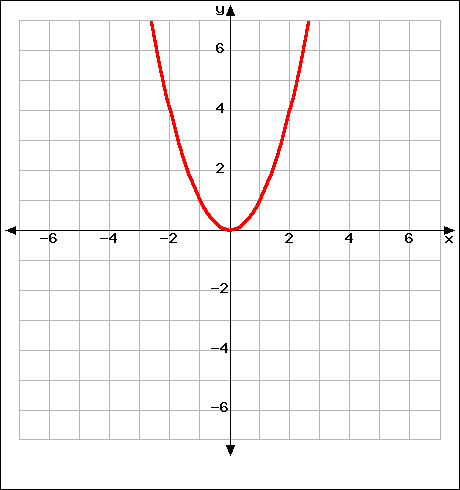
Look at this graph of \(y=x^2\text{.}\)
If \(y=x-2\) is graphed on the same coordinate plane, at how many points would the two graphs intersect?
Solution.
Solution
The graph of \(y=x-2\) would pass through (0,-2) and (2,0). So it could not intersect \(y=x^2\) for \(x\le 2\text{.}\)
But for \(x\ge 2\) it is easy to see that \(x^2> x-2\text{.}\)
Actually, if you think a bit harder you can see that \(x^2> x-2\) for all \(x\) but sometimes it is helpful to
have confirming evidence.

19.

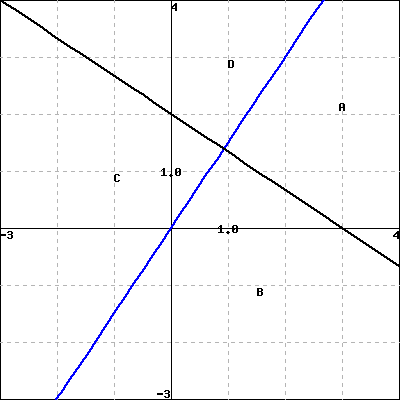
Determine which of the regions A, B, C or D, in the figure above, represents the graph of the given system of linear inequalities:
The regions A, B, C and D are nonoverlapping regions bounded by the indicated lines. (to get a better look at the graph, you can click on it).
\begin{equation*} \left\lbrace \begin{array}{r@{}r@{}r@{}r} 3 x \amp -2 y \amp \ge \amp 0 \\ 2 x \amp + 3 y \amp \ge \amp 6 \end{array} \right. \end{equation*}
Region: enter A, B, C or D

20.

Graph the system of inequalities. Tell whether the system is bounded or unbounded and list each corner point.
\begin{equation*} \left\{ \begin{array}{r@{}r@{}r} x + y \amp \ge \amp 1 \cr x+ 2 y \amp \le \amp 4 \cr 2 x+ y \amp \le \amp 4 \cr x \amp \ge \amp 0 \cr y \amp \ge \amp 0 \end{array} \right. \end{equation*}
Region is: Input bounded or unbounded
Corner Points:
If there is more than one corner point, type the points separated by a comma (i.e.: (1,2),(3,4)).
Answer 1.
Answer 2.
\(\left(1,0\right), \left(2,0\right), \left(0,2\right), \left(0,1\right), \left(1.33333333333333,1.33333333333333\right)\)

21.

Graph the system of inequalities. Tell whether the system is bounded or unbounded and list each corner point.
\begin{equation*} \left\{ \begin{array}{r@{}r@{}r@{}r} x \amp \ge \amp 4 \amp \cr y \amp \le \amp 9 \amp \cr y \amp \ge \amp x \cr x \amp \ge \amp 0 \amp \cr y \amp \ge \amp 0 \amp \end{array} \right. \end{equation*}
Region is: Input bounded or unbounded.
Corner Points:
If there is more than one corner point, type the points separated by a comma (i.e.: (1,2),(3,4)).
Answer 1.
Answer 2.
\(\left(4,9\right), \left(9,9\right), \left(4,4\right)\)

22.

Given the system of inequalities below, determine the shape of the feasible region and find the vertices of the feasible region. Give the shape as "triangle", "quadrilateral", or "unbounded". Report your vertices starting with the one which has the smallest x-value. If more than one vertex has the same, smallest x-value, start with the one that has the smallest y-value. Proceed clockwise from the first vertex. Leave any unnecessary answer spaces blank.
\begin{equation*} \begin{array}{l} x + y \geq 8 \cr 5 x + y \leq 13 \cr x \geq 0 \cr y \geq 0 \cr \end{array} \end{equation*}
The shape of the feasible region is (a) .
The first vertex is (,).
The second vertex is (,).
The third vertex is (,).
The fourth vertex is (,).
Answer 1.
Answer 2.
Answer 3.
Answer 4.
Answer 5.
Answer 6.
Answer 7.

23.

Given the system of inequalities below, determine the shape of the feasible region and find the vertices of the feasible region. Report your vertices starting with the one which has the smallest x-value. If more than one vertex has the same, smallest x-value, start with the one that has the smallest y-value. Proceed clockwise from the first vertex. Leave any unnecessary answer spaces blank.
\begin{equation*} \begin{array}{l} x + y \leq 6 \cr 6 x + y \geq 7 \cr x \geq 0 \cr y \geq 0 \cr \end{array} \end{equation*}
The feasible region is (a) .
The first vertex is (,).
The second vertex is (,).
The third vertex is (,).
The fourth vertex is (,).
Answer 1.
Answer 2.
Answer 3.
Answer 4.
Answer 5.
Answer 6.
\(1.16666666666667\)
Answer 7.

24.

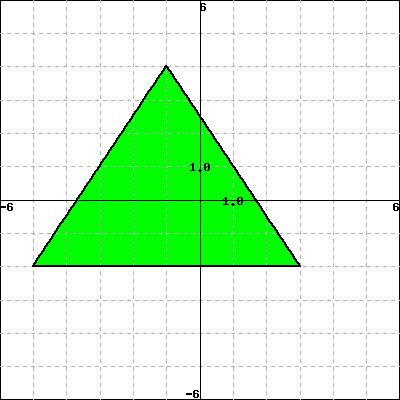
Choose 3 inequalities that form a system whose graph is the shaded region shown above.