Section Econ 201
This set of exercises is to help you assess your own algebra background knowledge before beginning Econ 201. For more algebra practice resources, as well as links to study and review materials, checkout the complete Reed Math Trailhead.
Subsection Quantitative Reasoning
Percentages and Proportions
Checkpoint 32. Convert a Percent to a Decimal.
Checkpoint 33. Convert a Decimal to a Percent.
Checkpoint 34. Convert a Percent to a Fraction.
Checkpoint 35. Calculate a Percentage of a Quantity.
In last season’s basketball games, Ivan made \(90\%\) in free throws. If he attempted a total of \(270\) free throws, how many free throws did he make?
Ivan made free throws last season.
Solution.
This problem can be boiled down to this question: What is \(90\%\) of \(270\text{?}\) We will show multiple methods to solve this problem.
Method 1
We will use proportion to solve this problem. Assume \(90\%\) of \(270\) is \(x\text{,}\) so “\(90\) out of \(100\)” corresponds to “\(x\) out of \(270\)”.
We will write and solve the proportion:
\(\displaystyle{\begin{aligned}[t]
\frac{90}{100} \amp = \frac{x}{270} \\
100x \amp = 90 \cdot 270 \\
100x \amp = 24300 \\
\frac{100x}{100} \amp = \frac{24300}{100} \\
x \amp = 243
\end{aligned}
}\)
Ivan made \(243\) free throws last season.
Method 2
We will use the percentage formula to solve this problem. This translation from English to math may help you remember the percentage formula.
\(2 \text{ is } 50\% \text{ of } 4 \iff 2 = 0.5 \cdot 4\)
The question is: What is \(90\%\) of \(270\text{?}\) Assume \(x\) is \(90\%\) of \(270\text{.}\) We have:
\(\displaystyle{
\begin{aligned}
x \amp = 0.9 \cdot 270 \\
\amp = 243
\end{aligned}
}\)
Ivan made \(243\) free throws last season.
Method 3
-
“what” is the percentage,
-
\(90\%\) is the rate,
-
\(270\) is the base (following the word “of”).
By the formula \(\text{percentage} = \text{rate} \cdot \text{base}\text{,}\) we do a multiplication to solve the problem:
\(\displaystyle{ \text{percentage } = \text{rate} \cdot \text{base} = 90\% \cdot 270 = 0.9 \cdot 270 = 243 }\)
Ivan made \(243\) free throws last season.
Checkpoint 36. Calculate a Percentage in Context.
A county has \(49500\) residents. In the last election, \(54\%\) turned out to vote. How many residents voted?
In the last election, residents in the county turned out to vote.
Solution.
This problem can be boiled down to this question: What is \(54\%\) of \(49500\text{?}\) We will show multiple methods to solve this problem.
Method 1
We will use proportion to solve this problem. Assume \(54\%\) of \(49500\) is \(x\text{,}\) so “\(54\) out of \(100\)” corresponds to “\(x\) out of \(49500\)”.
We will write and solve the proportion:
\(\displaystyle{\begin{aligned}[t]
\frac{54}{100} \amp = \frac{x}{49500} \\
100x \amp = 54 \cdot 49500 \\
100x \amp = 2673000 \\
\frac{100x}{100} \amp = \frac{2673000}{100} \\
x \amp = 26730
\end{aligned}
}\)
In the last election, \(26730\) residents in the county. turned out to vote.
Method 2
We will use the percentage formula to solve this problem. This translation from English to math may help you remember the percentage formula.
\(2 \text{ is } 50\% \text{ of } 4 \iff 2 = 0.5 \cdot 4\)
The question is: What is \(54\%\) of \(49500\text{?}\) Assume \(x\) is \(54\%\) of \(49500\text{.}\) We have:
\(\displaystyle{
\begin{aligned}
x \amp = 0.54 \cdot 49500 \\
\amp = 26730
\end{aligned}
}\)
In the last election, \(26730\) residents in the county. turned out to vote.
Method 3
-
“what” is the percentage,
-
\(54\%\) is the rate,
-
\(49500\) is the base (following the word “of”).
By the formula \(\text{percentage} = \text{rate} \cdot \text{base}\text{,}\) we do a multiplication to solve the problem:
\(\displaystyle{ \text{percentage } = \text{rate} \cdot \text{base} = 54\% \cdot 49500 = 0.54 \cdot 49500 = 26730 }\)
In the last election, \(26730\) residents in the county. turned out to vote.
Checkpoint 37. Calculate a Sale Price.
A painting is on sale with \(35\%\) off. Its original price was \({\$400.00}\text{.}\) What is its price on sale?
The painting sells for on sale.
Solution.
This problem can be boiled down to this question: What is \(65\%\) of \(400\text{?}\) We will show multiple methods to solve this problem.
Method 1
We will use proportion to solve this problem. Assume \(65\%\) of \(400\) is \(x\text{,}\) so “\(65\) out of \(100\)” corresponds to “\(x\) out of \(400\)”.
We will write and solve the proportion:
\(\displaystyle{\begin{aligned}[t]
\frac{65}{100} \amp = \frac{x}{400} \\
100x \amp = 65 \cdot 400 \\
100x \amp = 26000 \\
\frac{100x}{100} \amp = \frac{26000}{100} \\
x \amp = 260
\end{aligned}
}\)
The painting sells for \({\$260.00}\) on sale.
Method 2
We will use the percentage formula to solve this problem. This translation from English to math may help you remember the percentage formula.
\(2 \text{ is } 50\% \text{ of } 4 \iff 2 = 0.5 \cdot 4\)
The question is: What is \(65\%\) of \(400\text{?}\) Assume \(x\) is \(65\%\) of \(400\text{.}\) We have:
\(\displaystyle{
\begin{aligned}
x \amp = 0.65 \cdot 400 \\
\amp = 260
\end{aligned}
}\)
The painting sells for \({\$260.00}\) on sale.
Method 3
-
“what” is the percentage,
-
\(65\%\) is the rate,
-
\(400\) is the base (following the word “of”).
By the formula \(\text{percentage} = \text{rate} \cdot \text{base}\text{,}\) we do a multiplication to solve the problem:
\(\displaystyle{ \text{percentage } = \text{rate} \cdot \text{base} = 65\% \cdot 400 = 0.65 \cdot 400 = 260 }\)
The painting sells for \({\$260.00}\) on sale.
Checkpoint 38. Calculate a Price after Markup.
A watch’s wholesale price was \({\$260.00}\text{.}\) The retailer marked up the price by \(40\%\text{.}\) What’s the watch’s new price (markup price)?
The watch’s markup price is .
Solution.
First, we need to find the amount of increase in price. It’s given that the watch’s price was marked up by \(40\%\) of its original price, \({\$260.00}\text{.}\)
The problem can be boiled down to this question: What is \(40\%\) of \(260\text{?}\) We will show multiple methods to solve this problem.
Method 1
We will use proportion to solve this problem. Assume \(40\%\) of \(260\) is \(x\text{,}\) so “\(40\) out of \(100\)” corresponds to “\(x\) out of \(260\)”.
We will write and solve the proportion:
\(\displaystyle{\begin{aligned}[t]
\frac{40}{100} \amp = \frac{x}{260} \\
100x \amp = 40 \cdot 260 \\
100x \amp = 10400 \\
\frac{100x}{100} \amp = \frac{10400}{100} \\
x \amp = 104
\end{aligned}
}\)
The amount of price increase was \({\$104.00}\text{,}\) so the new price is \({\$260.00}+{\$104.00}={\$364.00}\text{.}\)
So the watch’s markup price is \({\$364.00}\text{.}\)
Method 2
We will use the percentage formula to solve this problem. This translation from English to math may help you remember the percentage formula.
\(2 \text{ is } 50\% \text{ of } 4 \iff 2 = 0.5 \cdot 4\)
The question is: What is \(40\%\) of \(260\text{?}\) Assume \(x\) is \(40\%\) of \(260\text{.}\) We have:
\(\displaystyle{
\begin{aligned}
x \amp = 0.4 \cdot 260 \\
\amp = 104
\end{aligned}
}\)
The amount of price increase was \({\$104.00}\text{,}\) so the new price is \({\$260.00}+{\$104.00}={\$364.00}\text{.}\)
So the watch’s markup price is \({\$364.00}\text{.}\)
Method 3
-
“what” is the percentage,
-
\(40\%\) is the rate,
-
\(260\) is the base (following the word “of”).
By the formula \(\text{percentage} = \text{rate} \cdot \text{base}\text{,}\) we do a multiplication to solve the problem:
\(\displaystyle{ \text{percentage } = \text{rate} \cdot \text{base} = 40\% \cdot 260 = 0.4 \cdot 260 = 104 }\)
The amount of price increase was \({\$104.00}\text{,}\) so the new price is \({\$260.00}+{\$104.00}={\$364.00}\text{.}\)
So the watch’s markup price is \({\$364.00}\text{.}\)
Checkpoint 39. Write a Ratio as a Reduced Fraction.
Write the given ratio as a fraction in simplest form.
`8` to `20=`
Reduced Fraction: numeric
Checkpoint 40. Solve a Proportion with an Unknown Numerator.
Checkpoint 41. Solve a Proportion with an Unknown Denominator.
Checkpoint 42. Use a Proportion to Calculate a Dosage.
Set up a proportion to solve the application problem. Round your answer to the nearest milliliter:
Pediatricians prescribe 60 milliliters (ml) of acetaminophen for every 20 pounds of a child’s weight. How many milliliters of acetaminophen will the doctor prescribe for Jocelyn, who weighs 65 pounds?
Solution: ml (rounded to the nearest ml)
Solution.
The ratio given is:
\(\displaystyle{\frac{60 \; \textrm{ml}}{20 \; \textrm{lbs}}}\)
We can set up a ratio, making sure that the units are the same on each side.
\(\displaystyle{\frac{60 \; \textrm{ml}}{20 \; \textrm{lbs}}=\frac{x \; \textrm{ml}}{65 \; \textrm{lbs}}}\)
\(\displaystyle{\frac{60}{20}=\frac{x}{65}}\)
Set the cross products equal:
\(20x = 65\cdot60\)
\(20x = 3900\)
Divide both sides by 20.
\(x = 195\)
Checkpoint 43. Scale a Recipe with a Proportion.
Set up a proportion to solve the application problem. Enter a reduced fraction or integer as your final answer.
An oatmeal cookie recipe calls for \(\frac{1}{4}\) cup of butter to make 6 cookies. Hilda needs to make 42 cookies for the bake sale. How many cups of butter will she need?
Solution: cups
Solution.
Let x = the number of cups of butter that Hilda needs.
We can use the proportion:
\(\displaystyle{\frac{\frac{1}{4}}{6}=\frac{x}{42}}\)
Set the cross products equal:
\(6x = \frac{1}{4} \cdot 42\)
\(6x = \frac{1}{4} \cdot \frac{42}{1}\)
\(6x = \frac{42}{4}\)
\(x = \frac{42}{4} \div 6\)
\(x = \frac{42}{4} \cdot \frac{1}{6}\)
\(x = \frac{42}{24}\)
\(x = {{\frac{7}{4}}}\)
Reading Tables and Graphs
Checkpoint 44. Analyze Changes in Measures of Center.
the table below shows the number of books the Jefferson Middle school students read
each month for nine months.
| Month | Sept. | Oct. | Nov. | Dec. | Jan. | Feb. | Mar. | Apr. | May |
| Number of Books | 293 | 280 | 266 | 280 | 289 | 279 | 275 | 296 | 271 |
If the students read only 101 books for the month of June, which measure of central tendency will have the greatest change?
-
All measures will have an equal change.
-
The mean will have the greatest change.
-
The median will have the greatest change.
-
The mode will have the greatest change.
Solution.
Solution
The mode ( the number that occurs most frequently) is 280 and will not change
The median (the central number) is 280 and will change to 279.5 (the average of 280 and 279),
Since the mean (the average of the numbers) is about 280 and we add 101 which is about 180 less
than the mean, and there are now 10 values, the mean will decrease by approximately \(180/10=18\text{.}\)
Checkpoint 45. Complete a Percent, Fraction, and Decimal Table.
Complete the table of values.
| Percent | Fraction | Decimal |
| \(40\) | \(2/5\) | \(.4\) |
| \(9\) | ||
| 51/100 | ||
| \(2.05\) |
Solution.
Row 1 To convert a percent into a fraction, divide it by 100 and reduce.
\(9\% = \frac{9}{100} = {{\frac{9}{100}}}\)
To convert a percent into a decimal, move the decimal two places to the left.
\(9\% = {0.09}\)
Row 2 To convert a fraction into a percent, we can set up the proportion:
\({{\frac{51}{100}}} = \frac{p}{100}\)
\(p = {{\frac{51}{100}}} \cdot 100 = {51}\%\)
Now we can convert the percent to a decimal by moving the decimal two places to the left.
\({51}\% = {0.51}\)
Row 3 To convert a decimal to a percent, move the decimal two places to the right.
\(2.05 = {205}\%\)
Put the percent over 100 (and reduce) to convert it to a fraction.
\(\frac{{205}}{100} = {{\frac{41}{20}}}\)
Summary
\(9\% = {{\frac{9}{100}}} = {0.09}\)
\({51}\% = {{\frac{51}{100}}} = {0.51}\)
\({205}\% = {{\frac{41}{20}}} = 2.05\)
Checkpoint 46. Calculate Probabilities from a Two-Way Table.
In a survey of 205 people, the following data were obtained relating gender to political orientation:
| Republican (R) | Democrat (D) | Libertarian (L) | Total | |
| Male (M) | 54 | 27 | 20 | 101 |
| Femal (F) | 49 | 38 | 17 | 104 |
| Total | 103 | 65 | 37 | 205 |
A person is randomly selected. What is the probability that the person is:
a) Male?
b) Male and a Democrat?
c) Male given that the person is a Democrat?
d) Republican given that the person is Male?
e) Female given that the person is a Libertarian?
f) Are the events Male and Republican independent? Enter yes or no.
Checkpoint 47. Interpret a Rate from a Graph.
Look at this graph.
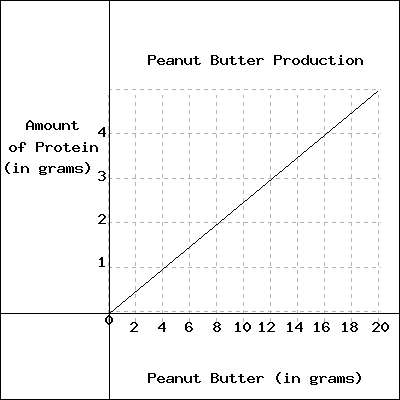
How many grams of protein are in each gram of peanut butter?
-
\(\displaystyle \frac{2}{1}\)
-
\(\displaystyle \frac{1}{2}\)
-
\(\displaystyle \frac{4}{1}\)
-
\(\displaystyle \frac{1}{4}\)
Checkpoint 48. Calculate the Mean and Median.
Find the mean and median of this group of numbers:
\(\displaystyle{ 9,\;\;16,\;\;18,\;\;6,\;\;16 }\)
Solution.
Find the mean
To find the mean of a group of numbers, we first add up all numbers and find their sum:
\(\displaystyle{ \text{sum} = 9+16+18+6+16 = 65 }\)
Next, we divide the sum by how many numbers there are:
\(\displaystyle{ \text{mean} = \frac{65}{5} = 13 }\)
The mean of this group of numbers is \(13\text{.}\)
Find the median
To find the median of a list of number, we first need to order these numbers from smallest to largest:
\(\displaystyle{ 6,\;\;9,\;\;16,\;\;16,\;\;18 }\)
The number in the middle is the median.
The median of this group of numbers is \(16\text{.}\)
Checkpoint 49. Calculate the Mean, Median, and Mode.
Find the mean, median, and mode of the following dataset:
\(\displaystyle{ 3, 1, 3, 8, 10 }\)
Mean = .
Median = .
Mode =
Solution.
The mean is the average of the numbers. To find the mean add the values and then divide by the number of values (5).
Mean = \((3 + 1 + 3 + 8 + 10) \div 5\)
Mean = \(25 \div 5\)
Mean = \(5\)
The median is the middle number. First put the values in order, from smallest to largest:
\(1, 3, 3, 8, 10\)
The middle number is the 3rd value, 3.
The mode is the vale that occurs most frequently. Since there are two 3’s, the mode is: 3.
Subsection Algebraic Foundations
Fractions and Fractional Expressions
Checkpoint 50. Add and Simplify Fractions.
Checkpoint 51. Evaluate Expressions with Fractional Inputs.
Evaluate each expression if \(a=-{\frac{1}{5}},\ b={\frac{5}{7}},\ c= -1 \frac{1}{2},\
d=2\frac{1}{2}\text{.}\)
Your answer should be a reduced fraction or a mixed number.
a) \(4a=\)
b) \(a+cd=\)
c) \(9d+\frac{7}{8}=\)
d) \(d(b+6)=\)
Solution.
Solution
a) \(4a=4\times -{\frac{1}{5}}=-{\frac{4}{5}}\)
b) \(a+cd= -{\frac{1}{5}} - 1{\textstyle\frac{1}{2}}\times 2{\textstyle\frac{1}{2}}= -3{\textstyle\frac{19}{20}}\)
c) \(9d+\frac{7}{8}=\(9\times 2{\textstyle\frac{1}{2}}+\frac{7}{8} = 23{\textstyle\frac{3}{8}}\)
d) \(d(b+6)=2{\textstyle\frac{1}{2}}({\frac{5}{7}}+6) = 16{\textstyle\frac{11}{14}}\)
Linear Equations and Graphs
Checkpoint 52. Find a Line Through Two Points.
Find a linear equation satisfying the following conditions:
Write your answer using integers or fractions.
Solution.
We are given two points:
Start by finding the slope:
\(m = \frac{y_2 - y_1}{x_2 - x_1} = \frac{6 + 1}{-10 - 5} = \frac{{7}}{{-15}} = {-{\frac{7}{15}}}\)
Now we can use the point-slope formula to write the equation of this line:
\(y - y_1 = m(x - x_1)\)
\(m = {-{\frac{7}{15}}}\)
\(x_1 = 5\)
\(y_1 = -1\)
\(y + 1 = {-{\frac{7}{15}}}(x - 5)\)
To put the equation in slope-intercept form, distribute -7/15 and then add -1 to both sides.
\({y-\left(-1\right)} = {-{\frac{7}{15}}}x - {-{\frac{7}{15}}} \cdot 5\)
\({y-\left(-1\right)} = {-\left({\frac{7}{15}}\right)x+{\frac{7}{3}}}\)
\(y = {-{\frac{7}{15}}}x + {{\frac{4}{3}}}\)
Note: To multiply fractions, we multiply straight across. For example \(\frac{2}{5} \cdot 6 = \frac{2}{5} \cdot \frac{6}{1} = \frac{12}{5}\text{.}\)
To add or subtract fractions we need a least common denominator (LCD). For example, \(\frac{2}{5} - 3 = \frac{2}{5} - \frac{3}{1} = \frac{2}{5} - \frac{15}{5} = -\frac{13}{5}\text{.}\)
Checkpoint 53. Write a Line from Its Slope and a Point.
Find an equation of the line with slope \(\displaystyle{{{\frac{4}{3}}} }\) that passes through the point \((-3,-3)\text{.}\) Write your solution in slope-intercept form.
Solution.
When trying to find the equation of a line with some information, start with the equation in slope-intercept form, that is, \(y = mx+b\text{.}\) Then substitute in any known information. In this case, we know the slope is \(m={{\frac{4}{3}}}\text{,}\) or
\(\displaystyle{ y = {{\frac{4}{3}}} x + b }\)
Next, substitute in the point \((-3,-3)\) or
\begin{equation*}
\begin{aligned}
-3 \amp = ({{\frac{4}{3}}})(-3) + b \\
-3 \amp = {-4} + b
\end{aligned}
\end{equation*}
Next, substract \({-4}\) from both sides:
\begin{equation*}
{1} = b
\end{equation*}
and finally plug this value of b into the equation:
\begin{equation*}
y = {{\frac{4}{3}}} x + {1}
\end{equation*}
Checkpoint 54. Read and Model a Line from Its Graph.
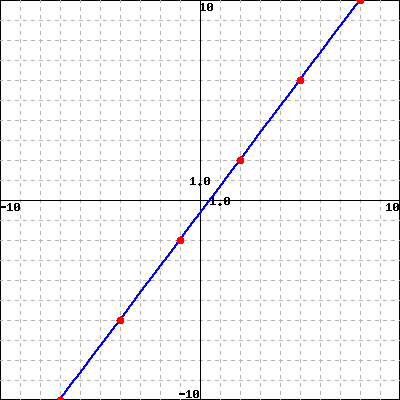
The graph of the function \(y=f(x)\) is given by the line displayed above.
Find \(f(-1)=\)
Find \(f(2)=\)
So, the slope is \(m=\)
Find an equation for the line graphed above:
Hint.
Solution.
The graphed line passes through the points: \(A = (-4,-6)\text{,}\) \(B = (-1,-2)\text{,}\) \(C = (2,2)\)
Select any pair of points on the line to compute the slope:
\(m = \frac{\Delta y}{\Delta x} = \frac{-2 + 6}{-1 + 4} = {{\frac{4}{3}}}\)
Use the point-slope form of a line:
\(y = m (x - x_A) + y_A\)
\(y = {{\frac{4}{3}}\mathopen{}\left(x+1\right)-2}\)
Checkpoint 55. Find a Line’s Slope and Vertical Intercept.
A line has the equation \(\displaystyle{ -{2}x+y= 10 }\text{.}\) Find this line’s slope and \(y\)-intercept. If either of these do not exist, you may enter DNE or NONE.
This line’s slope is .
This line’s \(y\)-intercept is .
Solution.
When an equation of a line is written in the form \(y=mx+b\text{,}\) it is said to be in slope-intercept form. In this form, \(m\) is the line’s slope, and \(b\) is the coordinate on the \(y\)-axis where the line intercepts the \(y\)-axis.
In this problem, the line’s equation is given as \(\displaystyle{ -{2}x+y= 10 }\text{.}\) It would be helpful to algebraically rearrange this into slope-intercept form: \(y= mx+b\text{.}\)
\(\displaystyle{\begin{aligned}
-{2}x+y \amp = 10 \\
-{2}x+y\mathbf{{}+{2}x} \amp = 10\mathbf{{}+{2}x} \\
y \amp = {2}x+10
\end{aligned}
}\)
Now we can see the line’s slope is \({2}\text{,}\) and its \(y\)-intercept has coordinates \((0,10)\text{.}\)
Subsection Functions and Modeling
Evaluating Functions
Checkpoint 56. Evaluate a Function at Numeric and Symbolic Inputs.
Evaluate \(f(x)={2x^{2}+3}\) at the following values:
Solution.
\(=2(-2)^2 + 3\)
\(=2 \cdot 4 + 3\)
\(= {11}\)
\(=2(1)^2 + 3\)
\(=2 \cdot 1 + 3\)
\(= {5}\)
\(={2a^{2}+3}\)
\(2(2a)^2 + 3\)
\(2\cdot 4a^2 + 3\)
\({8a^{2}+3}\)
\(2(a + 2)^2 + 3\)
\(2({a^{2}+4a+4}) + 3\)
\({2a^{2}+8a+8} + 3\)
\({2a^{2}+8a+11}\)
Checkpoint 57. Evaluate a Quadratic Function.
Evaluate \(f(x)={-3x^{2}-4x}\) at the following values:
Modeling in Context
Checkpoint 58. Interpret a Function in Context.
Carl started saving in a piggy bank on his birthday. The function \(f(x)={5x+1}\) models the amount of money, in dollars, in Carl’s piggy bank. The independent variable represents the number of days passed since his birthday.
Interpret the meaning of \(f(5)=26\text{.}\)
-
A. The piggy bank started with `$26` in it, and Carl saves `$5` each day.
-
B. Five days after Carl started his piggy bank, there were `$26` in it.
-
C. Twenty-six days after Carl started his piggy bank, there were `$5` in it.
-
D. The piggy bank started with `$5` in it, and Carl saves `$26` each day.
Hint.
Solution.
For \(f(x)={5x+1}\text{,}\) the value of \(x\) represents the number of days passed since Carl’s birthday, and the value of \(f(x)\) represents the amount of money in the piggy bank.
It’s helpful to understand those values by units: \(x\) is in “days,” while \(f(x)\) is in “dollars.”
For \(f(5)=26\text{,}\) \(5\) represents \(5\) days, while \(26\) represents \(26\) dollars. The correct solution is: B. Five days after Carl started his piggy bank, there were `$26` in it.
Subsection Exponents and Logarithms
Exponent Rules
Checkpoint 59. Apply the Power and Product Rules.
Logarithm Basics

