To find the inverse function, first write the function as \(y={\frac{3x+9}{x+6}}\) and then solve for \(x\text{.}\) Then you can switch the \(y\)’s into \(x\)’s to have a function \(f^{-1}(x)\text{.}\)
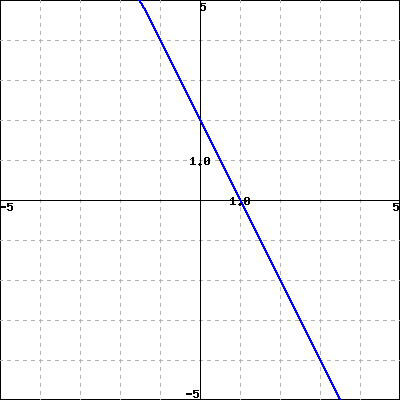
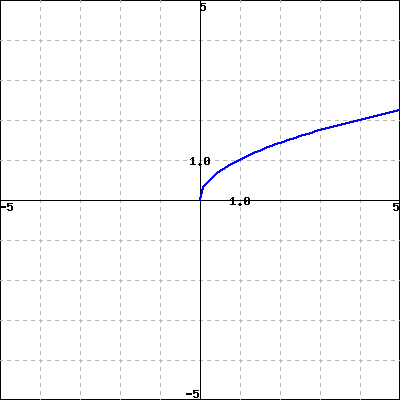
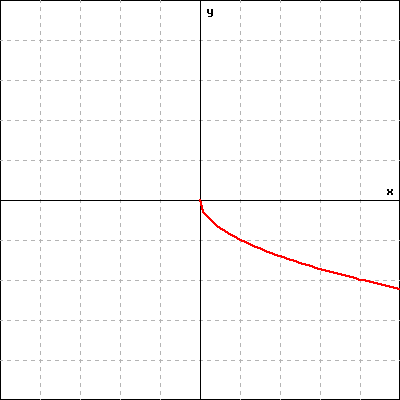
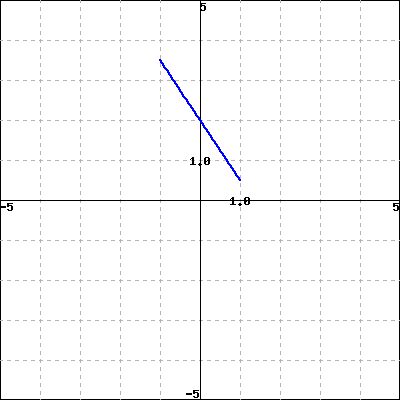
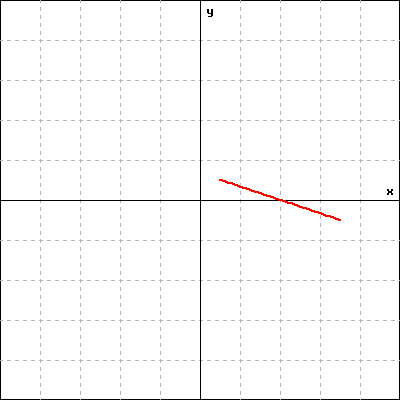
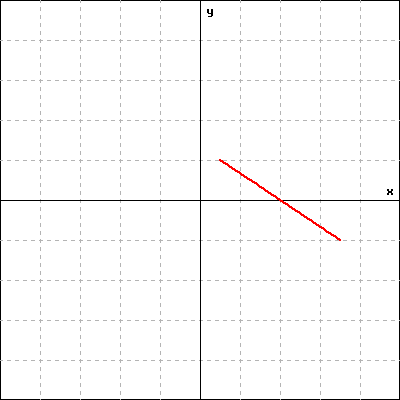
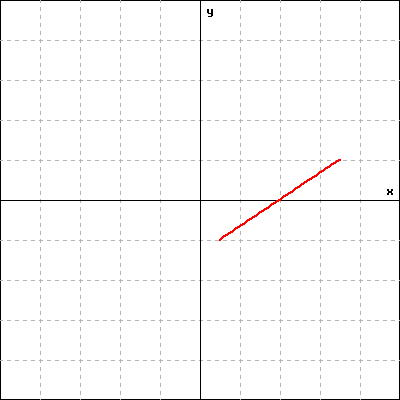
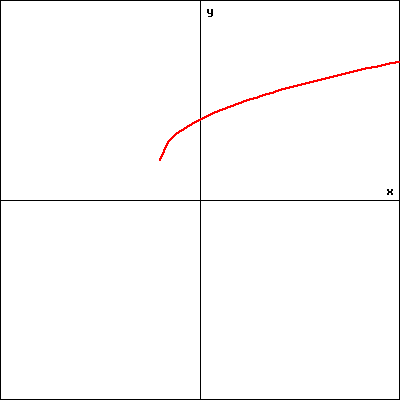
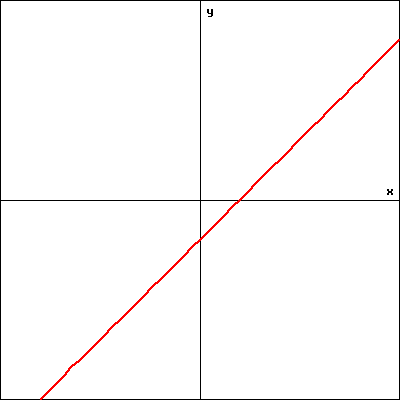
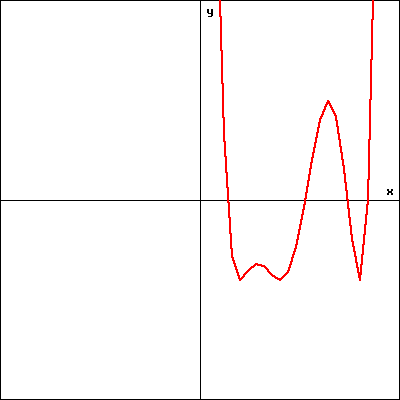
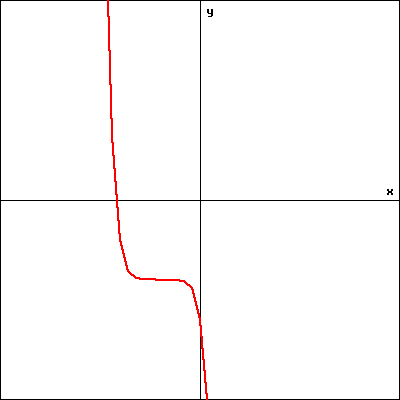
The given graph is the graph of the function \(f(x)\text{.}\) This means that the answer to \(f(0)\) is a \(y\)-value on the graph and the answer to \(f^{-1}(0)\) is an \(x\)-value on the graph.
An object dropped from a height of \(700\) feet has a height, \(h(t)\text{,}\) in feet after \(t\) seconds have elapsed, where \(t\ge 0\text{,}\) such that \(h(t)={700-16t^{2}}\text{.}\) Express \(t\) as a function of height \(h\text{,}\) and find the time to reach a height of \(100\) feet.
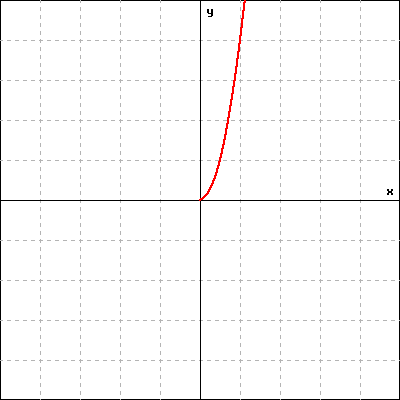
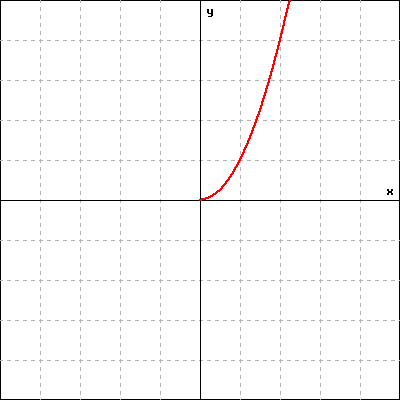
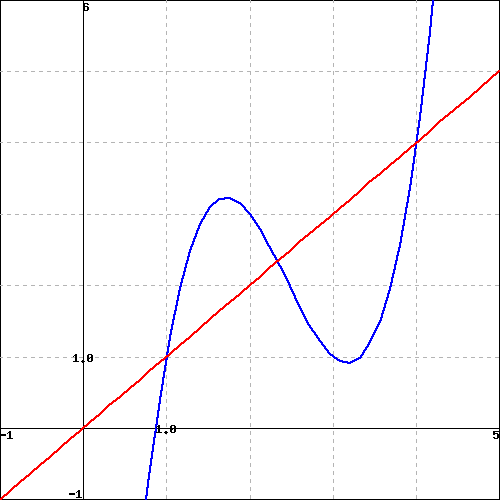
Find a restricted domain in which the function \(f(x)\) is \(one\,to\,one\text{,}\) non-decreasing, and on which \(f(x)\) achieves its entire range. Use interval notation.
To convert from x degrees Celsius to y degrees Fahrenheit, we use the formula \(\displaystyle{ f(x) = \frac{9}{5} x + 32 }\text{.}\) Find the inverse function, if it exists, and be sure you could explain its meaning.
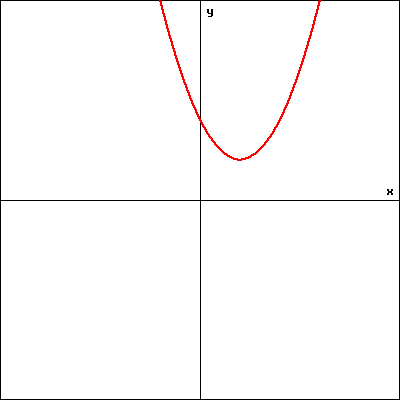
At this point we cannot determine what \(x\) is exactly. It could be \(\sqrt{y-4}\) or it could be \(-\sqrt{y-4}\text{.}\) Since we cannot solve for \(x\) in terms of \(y\text{,}\)\({x^{2}+4}\) is not a one-to-one function of \(x\text{.}\)
At this point we cannot determine what \(x\) is exactly. Maybe \(x-2=y\) or maybe \(x-2=-y\text{.}\) So maybe \(x=y+2\) or maybe \(x=-y+2\text{.}\) Since we cannot solve for \(x\) in terms of \(y\text{,}\)\({\left|x-2\right|}\) is not a one-to-one function of \(x\text{.}\)