Print preview
Worksheet Right Triangles
2.
3.
4.
5.
6.
7.
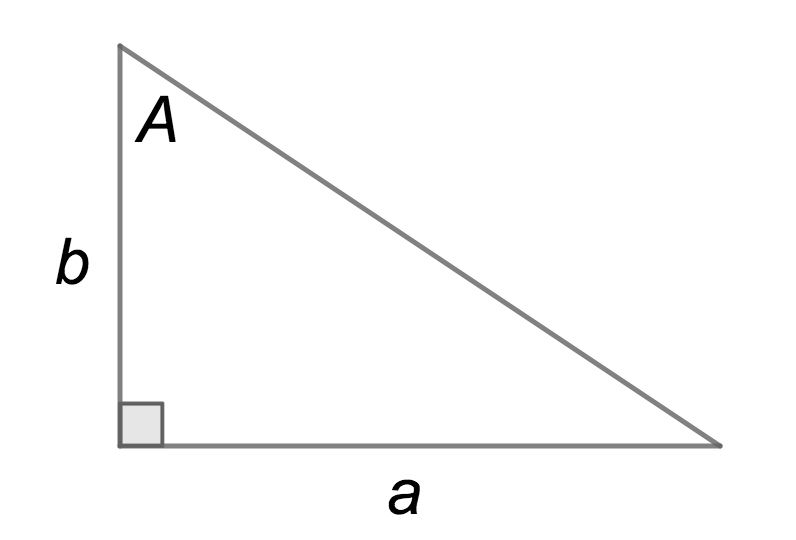
Refer to the right triangle in the figure. Click on the picture to see it more clearly.
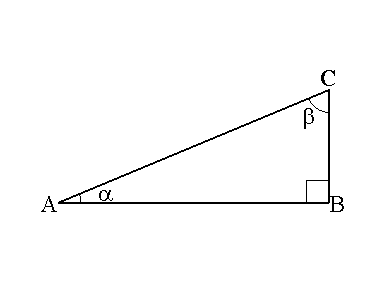
If , \(AC=6\) and the angle \(\alpha=25 ^\circ\text{,}\) find any missing angles or sides. Give your answer to at least 3 decimal digits.
AB =
BC =
\(\beta\)=
8.
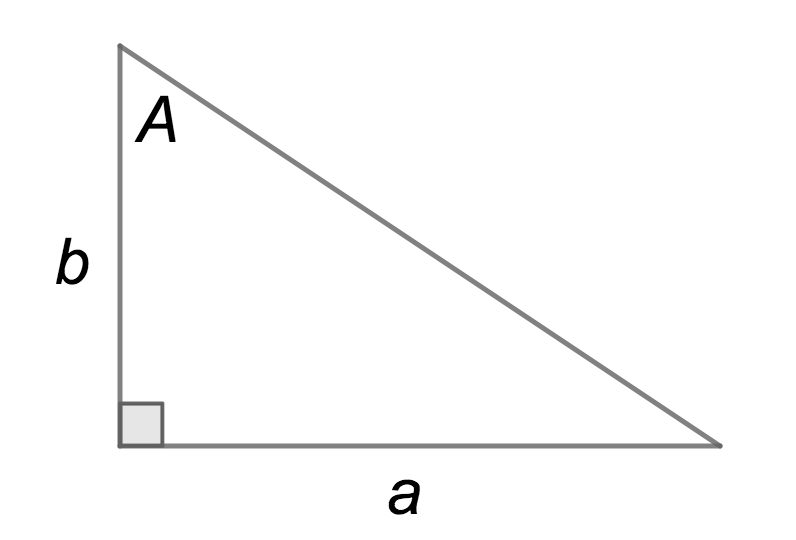
Refer to the right triangle in the figure. Click on the picture to see it more clearly.
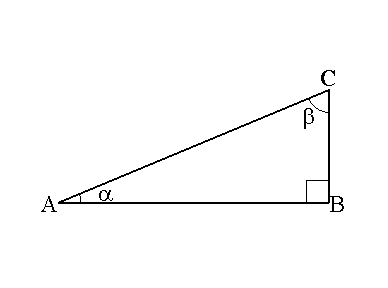
If , \(BC=7\) and the angle \(\beta=65 ^\circ\text{,}\) find any missing angles or sides. Give your answer to at least 3 decimal digits.
AB =
AC =
\(\alpha\)=
9.
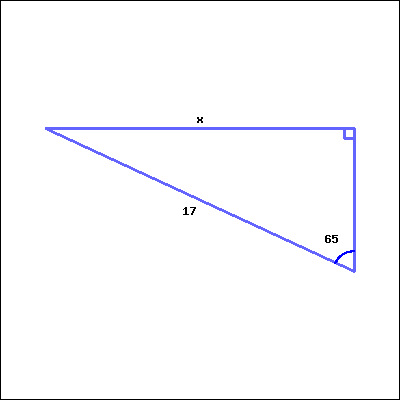
Find the length of \(x\text{.}\) Round your answer to two decimal places if needed.
\(x=\)
Solution.
By definition:
\(\displaystyle{ \sin \theta = \frac{\text{opposite leg}}{\text{hypotenuse}} }\)
\(\displaystyle{ \cos \theta = \frac{\text{adjacent leg}}{\text{hypotenuse}} }\)
\(\displaystyle{ \tan \theta = \frac{\text{opposite leg}}{\text{adjacent leg}} }\)
An acronym to help you memorize those 3 definitions is: SOH CAH TOA.
For this problem, the side marked as \(22\) is the hypotenuse, because it’s opposite to the right angle, and because it’s the longest side in the triangle.
The side marked as \(x\) is the “opposite leg” of the \(44\)-degree angle, because it is opposite to the angle.
Since we need to relate the hypotenuse and the angle’s opposite leg, we choose to use the sine function. The solution is:
\(\displaystyle{\begin{aligned}
\sin{44} \amp = \frac{x}{22} \\
\mathbf{22\cdot} \sin{44} \amp = \mathbf{22\cdot} \frac{x}{22} \\
22\cdot\sin{44} \amp = x \\
15.28 \amp \approx x
\end{aligned}
}\)
10.
A \(9.5\)-feet ladder is leaning against the wall. The base of the ladder forms a \(61\) degree angle with the ground. How high can the ladder reach on the wall?
Round your answer to two decimal places if needed.
The ladder can reach on the wall.
Solution.
Assume the ladder can reach \(x\) feet high on the wall. The following graph can represent this situation:
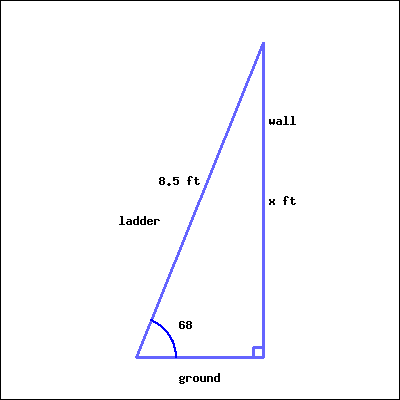
This has become a right triangle trigonometry problem.
By definition:
\(\displaystyle{ \sin \theta = \frac{\text{opposite leg}}{\text{hypotenuse}} }\)
\(\displaystyle{ \cos \theta = \frac{\text{adjacent leg}}{\text{hypotenuse}} }\)
\(\displaystyle{ \tan \theta = \frac{\text{opposite leg}}{\text{adjacent leg}} }\)
An acronym to help you memorize those 3 definitions is: SOH CAH TOA.
For this problem, the side marked as \({9.5\ {\rm ft}}\) is the hypotenuse, because it’s opposite to the right angle, and because it’s the longest side in the triangle.
The side marked as “\(x\) ft” is the “opposite leg” of the \(61\)-degree angle, because it is opposite to the angle.
Since we need to relate the hypotenuse and the angle’s opposite leg, we choose to use the sine function. The solution is:
\(\displaystyle{\begin{aligned}
\sin{61} \amp = \frac{x}{9.5} \\
\mathbf{9.5\cdot} \sin{61} \amp = \mathbf{9.5\cdot} \frac{x}{9.5} \\
9.5\cdot\sin{61} \amp = x \\
8.31 \amp \approx x
\end{aligned}
}\)
The ladder can reach approximately \(8.31\) feet high on the wall.
11.
12.
A kite flier wondered how high her kite was flying. She used a protractor to measure an angle of \(23^{\circ}\) from level ground to the kite string. If she used a full \(50\) yard spool of string, how high, in feet was the kite? (Disregard the string sag and assume that the string reel was at ground height.) Include units in your answer. All trig functions will be evaluated in degrees.
Height =
13.
The official Visual Flight Rules require that the distance between the ground and the bottom of the clouds to be more than 1000 feet for a plane to fly without instrumentation. At night, cloud height can be determined by aiming a searchlight straight upward and having an observer find the angle of elevation to the point at which the light hits the clouds. Suppose the observer stands 450 feet away from the searchlight and sights the beam of light on the clouds with an angle of elevation \(52 ^ \circ\text{.}\)
What is the height of the cloud cover?
(Round your answer to two decimal places.)
feet
Would the Visual Flight Rules allow a plane to fly without instrumentation in these conditions?
Answer ’yes’ or ’no’.

