Math Trailhead

Worksheet Piecewise Functions

1.

A B
C D
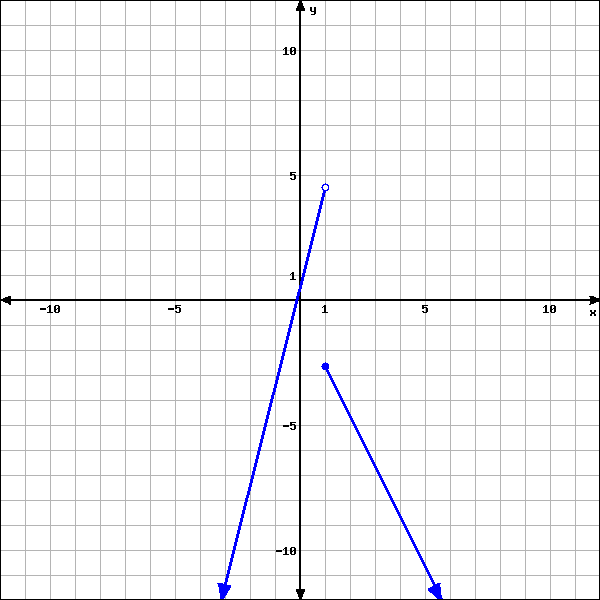
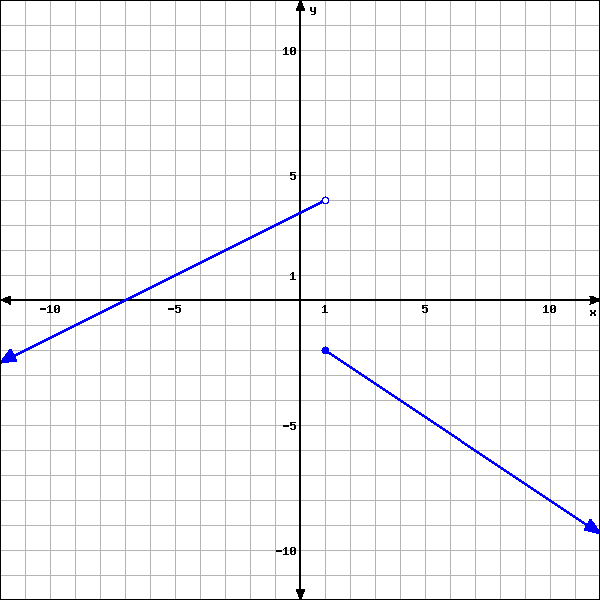
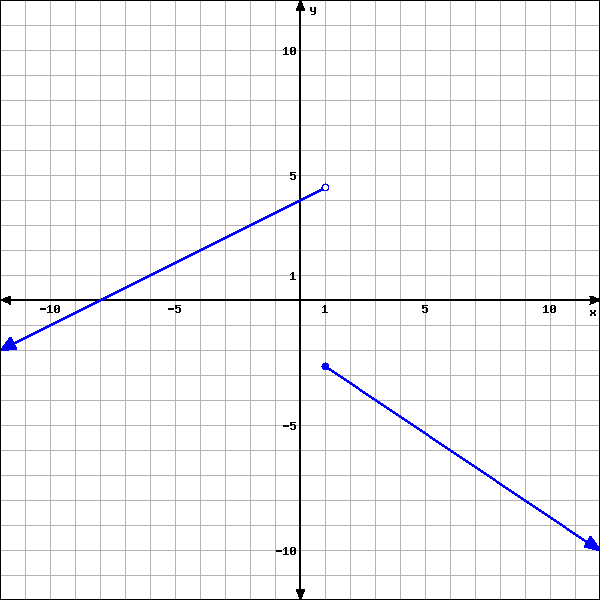
Choose the graph that represents the piecewise function
\(f(x) = \left\{ \begin{array}{lcl} \frac{1}{2}x+4 \amp \quad \amp \mbox{for } x \lt 1 \\ -\frac{2}{3}x - 2 \amp \quad \amp \mbox{for } x \geq 1 \\ \end{array}\right.\)
from the above choices. You may click a graph to enlarge it.
Correct Letter:
Answer.
\(\text{A}\)

2.

Let \(y = f(x)\) be the piecewise defined function given below.
\begin{equation*} f(x) = \left\lbrace \begin{array}{lcl} -x-2, \amp \amp \mbox{ if } x \leq -2, \\ 0, \amp \amp \mbox{ if } -2 \lt x \lt 2, \\ x-2, \amp \amp \mbox{ if } x \geq 2. \end{array} \right. \end{equation*}
a. \(f(-3) =\)
b. \(f(2) =\)
c. For what values of \(x\) is \(f(x) = 0\text{?}\)
d. Find the domain and range of \(f\text{.}\) (You may find it helpful to graph this function on your own paper to find the domain and range.) Your answers must be inequalities (not intervals).
Domain:
Range:
Answer 1.
Answer 2.
Answer 3.
\(-2\le x\le 2\)
Answer 4.
\(-\infty < x < \infty \)
Answer 5.
\(y\ge 0\)

3.

A restaurant offers a catering service which costs $15.00 per person with a $65.75 service charge. For parties of 65 or more people, a group discount applies, and the cost is $12.00 per person along with the service charge dropping to $32.00. Write a piecewise-defined linear function which calculates the total cost \(T\) of the catering service which serves \(n\) people.
\(\displaystyle T(n) = \left{ \begin{array}{cc} \amp \\ \amp \\ \amp \\ \amp \\ \amp \\ \amp \\ \amp \\ \amp \\ \amp \\ \amp \\ \end{array}\right.\)
if \(n\) \(\geq\)
Answer 1.
\(15n+65.75\)
Answer 2.
Answer 3.
\(65-1\)
Answer 4.
\(12n+32\)
Answer 5.

4.

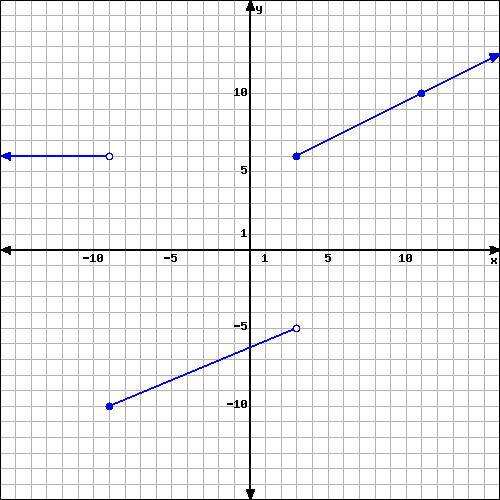
The graph of a piecewise function, \(f(x)\text{,}\) is depicted above. Find its equation:
\(\displaystyle f(x) = \left{ \begin{array}{cc} \amp \\ \amp \\ \amp \\ \amp \\ \amp \\ \amp \\ \amp \\ \amp \\ \amp \\ \amp \\ \amp \\ \amp \\ \amp \\ \amp \\ \amp \\ \amp \\ \end{array}\right.\) for \(x\) for \(x\) for \(x\)
Remarks: Note that β€œ<=” stands for β€œless than or equal” and β€œ>=” stands for β€œgreater than or equal.” You must have your browser window expanded wide enough to correctly display the above formula.
Answer 1.
Answer 2.
\({\verb!<!}\)
Answer 3.
Answer 4.
\(0.416667\mathopen{}\left(x+9\right)-10\)
Answer 5.
Answer 6.
\({\verb!<=!}\)
Answer 7.
\({\verb!<!}\)
Answer 8.
Answer 9.
\(0.5\mathopen{}\left(x-3\right)+6\)
Answer 10.
\({\verb!>=!}\)
Answer 11.

7.

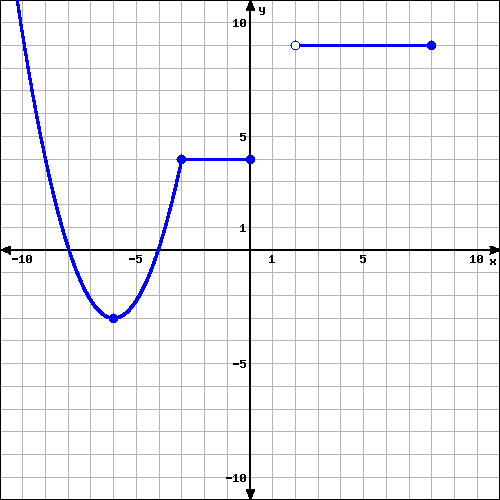
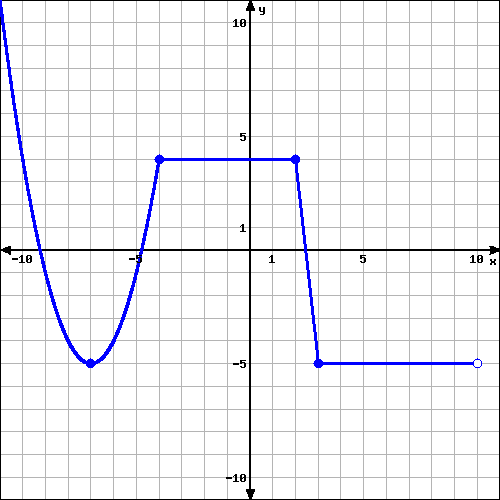
Given the graph of \(f(x)\) above, find the following and write your answers using interval notation:
(a) Domain:
(b) Range:
(c) Interval(s) on which \(f(x)\) is increasing:
(d) Interval(s) on which \(f(x)\) is decreasing:
(e) Interval(s) on which \(f(x)\) is constant:
(f) Relative maxima:
(g) Relative minima:
Answer 1.
\(\left(-\infty ,10\right)\)
Answer 2.
\(\left[-5,\infty \right)\)
Answer 3.
\(\left(-7,-4\right)\)
Answer 4.
\(\left(-\infty ,-7\right), \left(2,3\right)\)
Answer 5.
\(\left(-4,2\right), \left(3,10\right)\)
Answer 6.
\(\text{none}\)
Answer 7.

8.

A B
C D
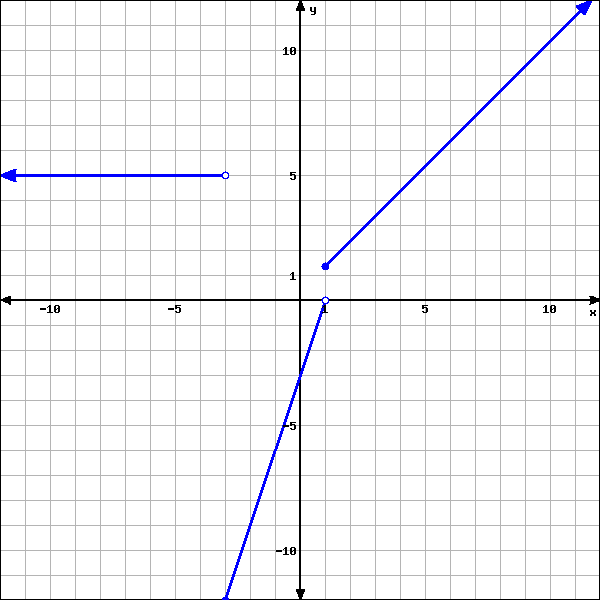
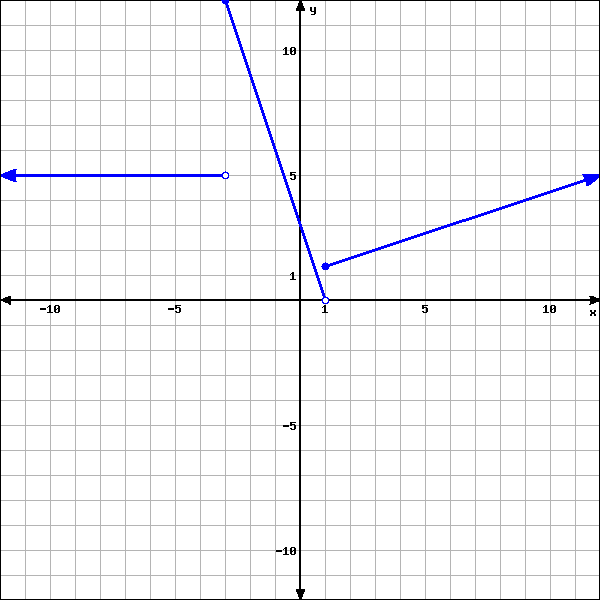
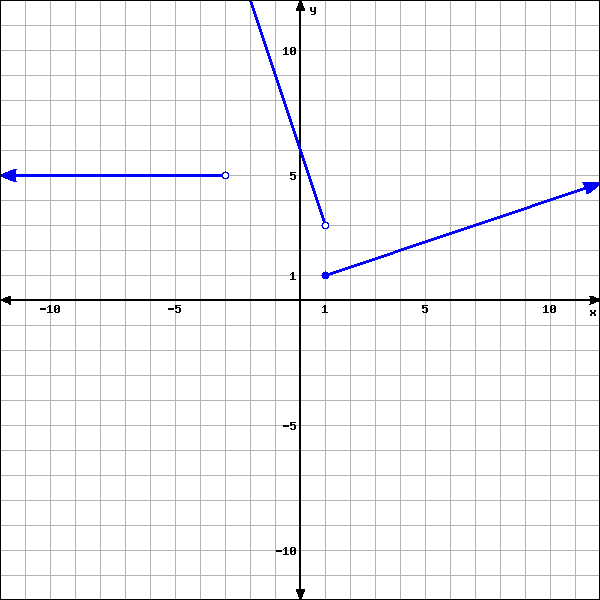
Choose the graph that represents the piecewise function
\begin{equation*} f(x) = \left{\begin{array}{ccl} 5 \amp \quad \amp \mbox{for } x \lt -3 \\ -3 x+3 \amp \quad \amp \mbox{for } -3 \leq x \lt 1 \\ \frac{1}{3}x+1 \amp \quad \amp \mbox{for } x \geq 1 \\ \end{array} \right. \end{equation*}
from the above choices. You may click a graph to enlarge it.
Correct Letter:
Answer.
\(\text{B}\)

9.

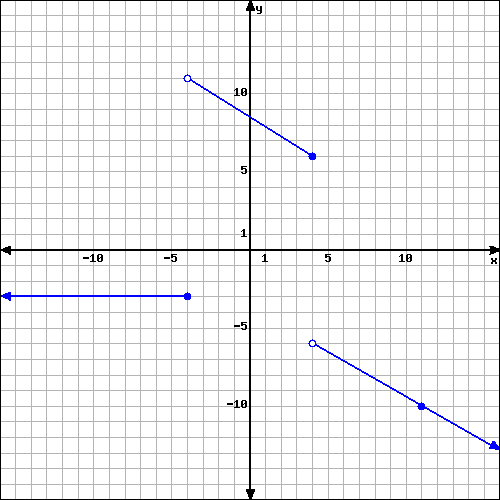
The graph of a piecewise function, \(f(x)\text{,}\) is depicted above. Find its equation:
\(\displaystyle f(x) = \left{ \begin{array}{cc} \amp \\ \amp \\ \amp \\ \amp \\ \amp \\ \amp \\ \amp \\ \amp \\ \amp \\ \amp \\ \amp \\ \amp \\ \amp \\ \amp \\ \amp \\ \amp \\ \end{array}\right.\) for \(x\) for \(x\) for \(x\)
Answer 1.
Answer 2.
\({\verb!<=!}\)
Answer 3.
Answer 4.
\(11-0.625\mathopen{}\left(x+4\right)\)
Answer 5.
Answer 6.
\({\verb!<!}\)
Answer 7.
\({\verb!<=!}\)
Answer 8.
Answer 9.
\(-\left(0.571429\mathopen{}\left(x-4\right)+6\right)\)
Answer 10.
\({\verb!>!}\)
Answer 11.

10.

Find \(\small{f(0), f(5), f(-5), f(3),}\) and \(\small{f(\sqrt{5}),}\) for:
\begin{equation*} \small{f(x) = \begin{cases}\displaystyle{\frac{3}{x}}\amp \text{if}\ x > 3\cr \displaystyle{2x}\amp \text{if}\ x \le 3\end{cases}} \end{equation*}
\(\small{f(0)}\) \(=\)
\(\small{f(5)}\) \(=\)
\(\small{f(-5)}\) \(=\)
\(\small{f(3)}\) \(=\)
\(\small{f(\sqrt{5})}\) \(=\)
Answer 1.
Answer 2.
Answer 3.
Answer 4.
Answer 5.
\(4.47214\)
Solution.
\(\small{x}\text{,}\)\(\small{x}\)\(\small{x}\text{.}\)\(\small{f(5), 5 > 3}\)\(\small{f(5) = \large{\frac{3}{5}}}\text{.}\)\(\small{\le 3}\text{,}\)
\begin{align*} \small{f(0)} \amp = \small{2 (0) = 0}\\ \small{f(-5)} \amp = \small{2 (-5) = -10} \\ \small{f(3)} \amp = \small{2 (3) = 6} \\ \small{f\left(\sqrt{5}\right)} \amp = \small{2 \left(\sqrt{5}\right) } \\ \end{align*}