Print preview
Worksheet Degrees and Radians
2.
3.
Convert \(279^{\circ}\) into radian measure:
Convert \(127^{\circ}\) into radian measure:
Convert \(73^{\circ}\) into radian measure:
Convert \(228^{\circ}\) into radian measure:
-
Enter your answer as a fraction of pi
-
You may also use decimal approximation, but your answer must be accurate to at least 3 decimal places.
Hint.
If you’re familiar with unit conversion, this is pretty much the same thing.
You want to multiply by a fraction that’s equivalent to 1 (because multiplying by 1 won’t change the value).
But the fraction will have different units in the numerator and denominator.
In the denominator you put the units that you want to remove, and in the numerator you put the units that you want to end up with.
In this case, you want to remove degrees, and have radians instead.
So you need two equivalent measurements - one in radians, and one in degrees.
Solution.
For converting between radians and degrees, we rely on the fact that \(360^{\circ} = 2\pi\) radians.
This means we can use the conversion factors: \(\frac{2\pi}{360^{\circ}}\) or \(\frac{360^{\circ}}{2\pi}\)
To convert from degrees, to radians, we need to cancel out the existing degrees.
That means putting \(360^{\circ}\) in the denominator.
So we’ll be using \(\frac{2\pi}{360^{\circ}}\text{,}\) which is often reduced: \(\frac{\pi}{180^{\circ}}\)
Note that both fractions are equivalent to 1, since we’re taking a measurement divided by the same measurement.
If you’re having trouble seeing that, think of \(\frac{1 \text{ft}}{12 \text{in}}\) or \(\frac{60 \text{min}}{1 \text{hr}}\text{.}\) They’re both equivalent to 1 as well.
-
\(\displaystyle 279^{\circ} \rightarrow 279^{\circ} \times \frac{\pi\text{ radians}}{180^{\circ}} \rightarrow \frac{279\pi\text{ radians}}{180} \rightarrow {\frac{31\pi }{20}}\text{ radians}\)
-
\(\displaystyle 127^{\circ} \rightarrow 127^{\circ} \times \frac{\pi\text{ radians}}{180^{\circ}} \rightarrow \frac{127\pi\text{ radians}}{180} \rightarrow {\frac{127\pi }{180}}\text{ radians}\)
-
\(\displaystyle 73^{\circ} \rightarrow 73^{\circ} \times \frac{\pi\text{ radians}}{180^{\circ}} \rightarrow \frac{73\pi\text{ radians}}{180} \rightarrow {\frac{73\pi }{180}}\text{ radians}\)
-
\(\displaystyle 228^{\circ} \rightarrow 228^{\circ} \times \frac{\pi\text{ radians}}{180^{\circ}} \rightarrow \frac{228\pi\text{ radians}}{180} \rightarrow {\frac{19\pi }{15}}\text{ radians}\)
4.
Convert \({4.91}\) radians into degrees:
Convert \({1.23}\) radians into degrees:
Convert \({4.43}\) radians into degrees:
Convert \({2.89}\) radians into degrees:
-
You may use decimal approximation, but your answer must be accurate to at least 3 decimal places.
Hint.
If you’re familiar with unit conversion, this is pretty much the same thing.
You want to multiply by a fraction that’s equivalent to 1 (because multiplying by 1 won’t change the value).
But the fraction will have different units in the numerator and denominator.
In the denominator you put the units that you want to remove, and in the numerator you put the units that you want to end up with.
In this case, you want to remove radians, and have degrees instead.
So you need two equivalent measurements - one in radians, and one in degrees.
Solution.
For converting between radians and degrees, we rely on the fact that \(360^{\circ} = 2\pi\) radians.
This means we can use the conversion factors: \(\frac{2\pi}{360^{\circ}}\) or \(\frac{360^{\circ}}{2\pi}\)
To convert from radians, to degrees, we need to cancel out the existing radians.
That means putting \(2 \pi\) radians in the denominator.
So we’ll be using \(\frac{360^{\circ}}{2\pi\text{ radians}}\text{,}\) which is often reduced: \(\frac{180^{\circ}}{\pi\text{ radians}}\)
Note that both fractions are equivalent to 1, since we’re taking a measurement divided by the same measurement.
If you’re having trouble seeing that, think of \(\frac{1 \text{ft}}{12 \text{in}}\) or \(\frac{60 \text{min}}{1 \text{hr}}\text{.}\) They’re both equivalent to 1 as well.
-
\(\displaystyle {4.91} \text{ radians} \rightarrow {4.91} \text{ radians} \times \frac{180^{\circ}}{\pi\text{ radians}} \rightarrow \frac{883.8^{\circ}}{\pi} \approx {281.322}^{\circ}\)
-
\(\displaystyle {1.23} \text{ radians} \rightarrow {1.23} \text{ radians} \times \frac{180^{\circ}}{\pi\text{ radians}} \rightarrow \frac{221.4^{\circ}}{\pi} \approx {70.4738}^{\circ}\)
-
\(\displaystyle {4.43} \text{ radians} \rightarrow {4.43} \text{ radians} \times \frac{180^{\circ}}{\pi\text{ radians}} \rightarrow \frac{797.4^{\circ}}{\pi} \approx {253.82}^{\circ}\)
-
\(\displaystyle {2.89} \text{ radians} \rightarrow {2.89} \text{ radians} \times \frac{180^{\circ}}{\pi\text{ radians}} \rightarrow \frac{520.2^{\circ}}{\pi} \approx {165.585}^{\circ}\)
5.
Convert \(\displaystyle{ {\frac{5\pi }{6}} }\) radians into degrees:
Convert \(\displaystyle{ {\frac{\pi }{2}} }\) radians into degrees:
Convert \(\displaystyle{ {\frac{7\pi }{6}} }\) radians into degrees:
Convert \(\displaystyle{ {\frac{7\pi }{4}} }\) radians into degrees:
Hint.
If you’re familiar with unit conversion, this is pretty much the same thing.
You want to multiply by a fraction that’s equivalent to 1 (because multiplying by 1 won’t change the value).
But the fraction will have different units in the numerator and denominator.
In the denominator you put the units that you want to remove, and in the numerator you put the units that you want to end up with.
In this case, you want to remove radians, and have degrees instead.
So you need two equivalent measurements - one in radians, and one in degrees.
Solution.
For converting between radians and degrees, we rely on the fact that \(360^{\circ} = 2\pi\) radians.
This means we can use the conversion factors: \(\frac{2\pi}{360^{\circ}}\) or \(\frac{360^{\circ}}{2\pi}\)
To convert from radians, to degrees, we need to cancel out the existing radians.
That means putting \(2 \pi\) radians in the denominator.
So we’ll be using \(\frac{360^{\circ}}{2\pi\text{ radians}}\text{,}\) which is often reduced: \(\frac{180^{\circ}}{\pi\text{ radians}}\)
Note that both fractions are equivalent to 1, since we’re taking a measurement divided by the same measurement.
If you’re having trouble seeing that, think of \(\frac{1 \text{ft}}{12 \text{in}}\) or \(\frac{60 \text{min}}{1 \text{hr}}\text{.}\) They’re both equivalent to 1 as well.
-
\(\displaystyle {\frac{5\pi }{6}} \text{ radians} \rightarrow {\frac{5\pi }{6}} \text{ radians} \times \frac{180^{\circ}}{\pi\text{ radians}} \rightarrow \frac{900^{\circ}\pi}{6\pi} \rightarrow 150^{\circ}\)
-
\(\displaystyle {\frac{\pi }{2}} \text{ radians} \rightarrow {\frac{\pi }{2}} \text{ radians} \times \frac{180^{\circ}}{\pi\text{ radians}} \rightarrow \frac{180^{\circ}\pi}{2\pi} \rightarrow 90^{\circ}\)
-
\(\displaystyle {\frac{7\pi }{6}} \text{ radians} \rightarrow {\frac{7\pi }{6}} \text{ radians} \times \frac{180^{\circ}}{\pi\text{ radians}} \rightarrow \frac{1260^{\circ}\pi}{6\pi} \rightarrow 210^{\circ}\)
-
\(\displaystyle {\frac{7\pi }{4}} \text{ radians} \rightarrow {\frac{7\pi }{4}} \text{ radians} \times \frac{180^{\circ}}{\pi\text{ radians}} \rightarrow \frac{1260^{\circ}\pi}{4\pi} \rightarrow 315^{\circ}\)
6.
Convert the following degree measures to radians.
(Write your answers as angles \(0 \le \theta \lt 2\pi\text{.}\) Write as a fraction using \(\fbox{pi}\) for \(\pi\text{.}\))
7.
Convert the following radian measures to degrees.
(Write your answers as angles \(0^\circ \le \theta \lt 360^\circ\text{.}\))
8.
Consider the pictures below. Click on the pictures to see them more clearly. Each angle \(\theta\) is an integer when measured in radians. Give the radian measure of the angle.
1.
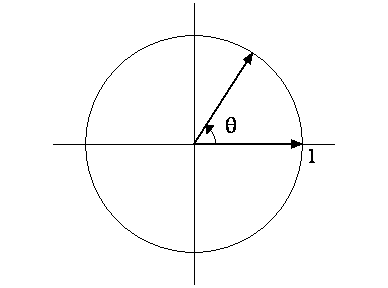
radian measure =
2.
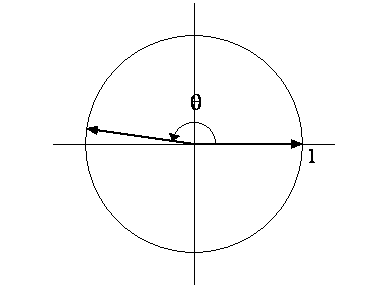
radian measure =
3.
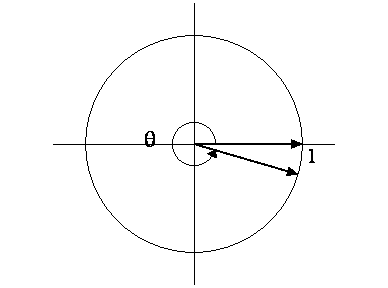
radian measure =
9.
Determine the exact radian measure for the angle \(310^{\circ}\text{.}\) Do not give a decimal approximation, and recall in order to enter \(\pi\) you must type pi.
\(310^{\circ} =\) radians
10.
11.
For each angle (in degrees) below, determine the quadrant in which the terminal side of the angle is found.
[NOTE: Enter ’1’ for quadrant I, ’2’ for quadrant II, ’3’ for quadrant III, and ’4’ for quadrant IV.]
(a) \(265^\circ\) is found in quadrant
(b) \(505^\circ\) is found in quadrant
(c) \(316^\circ\) is found in quadrant
(d) \(-264^\circ\) is found in quadrant
12.
For each angle listed in the table below, select the letter of the corresponding point on the unit circle, the value of the \(x\)-coordinate of the point, and the value of the \(y\)-coordinate of the point. Round the coordinates of the point to 3 decimal places. Don’t enter sin or cos. (You must approximate your answers.)
Solution.
SOLUTION
| Angle (in degrees) | Point (enter letter A-F) | \(x\)-coordinate | \(y\)-coordinate |
| \(800^{\circ}\) | B | 0.174 | 0.985 |
| \(150^{\circ}\) | C | -0.866 | 0.5 |
| \(45^{\circ}\) | A | 0.707 | 0.707 |
| \(250^{\circ}\) | E | -0.342 | -0.94 |
| \(-150^{\circ}\) | D | -0.866 | -0.5 |
| \(-400^{\circ}\) | F | 0.766 | -0.643 |
13.
Find two angles (one positive and one negative) that are coterminal with \(\displaystyle{ {\frac{7\pi }{6}} }\text{.}\)
is a positive angle that is coterminal with \(\displaystyle{ {\frac{7\pi }{6}} }\text{.}\)
is a negative angle that is coterminal with \(\displaystyle{ {\frac{7\pi }{6}} }\text{.}\)
-
You’ll have an easier time with this problem if you use fractions and pi instead of decimal approximations.
-
If you use decimal approximations, your answer must be correct to at least 3 decimal places.
Hint.
Solution.
There are many positive coterminal angles with \({\frac{7\pi }{6}}\text{.}\)
To find positive coterminal angles, we add full rotations.
You can think of this like spinning around in a full circle.
You end up facing exactly the same direction you were before you spun around.
Add one full rotation:
\({\frac{7\pi }{6}} + 2\pi \rightarrow {\frac{7\pi }{6}} + \frac{12\pi}{6} \rightarrow \frac{19\pi}{6}\)
Add two full rotations:
\({\frac{7\pi }{6}} + 4\pi \rightarrow {\frac{7\pi }{6}} + \frac{24\pi}{6} \rightarrow \frac{31\pi}{6}\)
You could even add more full rotations, there are infinitely many positive coterminal angles with \({\frac{7\pi }{6}}\text{.}\)
In other words, it doesn’t matter how many times you spin around,
as long as you end up facing the same direction you were before you started.
To find negative coterminal angles, we instead subtract full rotations.
Here, we’re just spinning circles in the opposite direction.
Subtract one full rotation:
\({\frac{7\pi }{6}} - 2\pi \rightarrow {\frac{7\pi }{6}} - \frac{12\pi}{6} \rightarrow \frac{-5\pi}{6}\)
Subtract two full rotations:
\({\frac{7\pi }{6}} - 4\pi \rightarrow {\frac{7\pi }{6}} - \frac{24\pi}{6} \rightarrow \frac{-17\pi}{6}\)
Again, we could subtract any number of full rotations.
There are an infinite number of negative coterminal angles as well.
In general: Let \(k\) be the number of times to spin around.
\(k\) can be positive or negative (depending on which direction you want to spin).
\({\frac{7\pi }{6}} + k(2\pi) \rightarrow {\frac{7\pi }{6}} + \frac{12k\pi}{6} \rightarrow \frac{(7+12k)\pi}{6}\)
Do you see how this relates to our answers above?
What happens when \(k\) is 1? Or -1?
What about when \(k\) is 2? Or -2?

